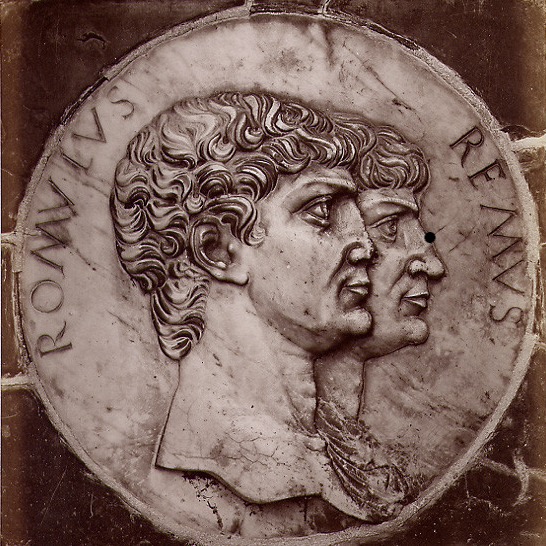
You’ve sort of heard of Romulus, even if you don’t think you have. He’s the man who founded and named Rome, modestly naming it after himself. He appeared in history out of a band of shepherds who had robbery as a sideline. He killed a king, and he killed his brother, and ruled Rome as king for almost 40 years. Then he vanished.
It began with Numitor, king of Alba Longa, a town in the Alban Hills. Numitor and his brother Amulius descended from Aeneas, who had escaped from the destruction of Troy. Amulius usurped the throne, killing Numitor’s son, Aegistus.
Numitor also had a daughter, Rhea Silvia, and Amulius forced her to become a Vestal Virgin, a kind of nunnery for aristocratic daughters. He did so to ensure that she would bear no heir. A Vestal Virgin who became pregnant was punished with death by being buried alive (a Vestal’s blood was sacred, so the living burial accomplished execution without blood being spilled). The complication was that she claimed to have been seduced by the god Mars and was pregnant with twins, giving them a connection to the gods. They were named Romulus and Remus.
Amulius ordered a servant to throw the twins into the Tiber. Rhea’s fate is unclear, but she may have been imprisoned. The Tiber was in flood stage, so the servant left the twins in a basket along the riverbank. The flood carried them away, but the basket hit an obstacle and was thrown ashore under a fig tree that was later called the Ficus Ruminalis. A female wolf who had just had pups found them. Her name was Lupa, and she nursed the twins and licked off the dirt from them. Lupa was not the only animal helper; a woodpecker also aided the twins by bringing them bits of food.
A shepherd named Faustulus found them and took them home to his wife, Acca Laurentia. The couple raised the twins alongside eleven of their own sons. The twins grew into strong and adventurous young men. They formed a gang of shepherd boys who not only herded livestock but defended their pastures and sometimes robbed travelers. In one of their escapades, they ran afoul of some of Numitor’s shepherds (the usurped king had not been murdered, perhaps because shedding royal blood made Amulius hesitant). Remus was captured, and Romulus tried to rescue him. Numitor recognized them as his missing grandsons.
The twins gathered a sizable force and, with it, attacked Alba Longa, killing Amulius and restoring Numitor to his throne. Ambitious, the twins decided to found their own city and rule it. They decided on an area that would become Rome but disagreed on the site. Remus insisted on the Aventine Hill, while Romulus insisted on the Palatine.
They decided on augury to resolve the difference; at dawn they’d watch from their hilltops for vultures, as an indication of the god’s preference. Remus saw six vultures and declared his choice was favored; Romulus claimed to have seen twelve of the birds, and claimed the number was more important than being first. Romulus then hitched a bullock and a heifer to a plow and plowed a furrow around his intended site, marking out its pomerium, a sort of city limits. As the walls were being built, Remus came by and vaulted over the wall to show his contempt. An angry Romulus killed his brother on the spot, striking him with a pickaxe or a shovel.
Rome was officially founded in 753 BCE. Romulus was only in his early 20s. He would rule as Rome’s first king until 716 BCE. Romulus successfully built his little city and populated it with shepherds and vagabonds, offering refuge to debtors and even murderers from elsewhere. Almost all were young men, and with few women, the future was uncertain. Romulus solved the problem by inviting nearby Sabines and Latins to celebratory games honoring the god of the harvest, a festival called the Consualia. Many families came for the festival.
Romulus ordered his men to kidnap marriageable virgins from the celebrants. His men took them into Rome and married them. Just how many is unknown, with one story saying 30 and another more than 600. The result was war. The forces of several angry cities attacked, and Romulus defeated them. In one battle, Romulus killed a king and stripped him of his armor, which became the first spolia optima, the most respected of war trophies. The Sabines were more formidable and fought the Romans to a draw. In the middle of the gory battle, the Sabine women appeared and pleaded for the fighting to stop. It worked, and the resulting peace united the Sabines and Romans under a dual monarchy of Romulus and the Sabine king, Titus Tatius. They co-ruled for five years, until Titus was killed in a riot in a neighboring city.
Rome’s later political structure evolved from what Romulus set up. He divided the population into three tribes, the Ramnes, Titienses, and Luceres, each overseen by a tribune. Each of the three was further subdivided into curias, presided over by a curio. Each curia was obligated to provide 100 soldiers and 10 horsemen. The horsemen became Romulus’ personal guards and were predecessors of the equites or equestrian class. Romulus chose 100 men from the most respected families, who formed the Senate, the predecessors of the patricii or patrician class. Rome prospered under his rule, expanding by absorbing several other towns and small cities into Rome’s orbit.
The king’s demise was as dramatic as his life. According to legend, Romulus vanished during a violent thunderstorm, swept up to heaven to join the gods. Another, darker version claims that senators, angered by his increasingly tyrannical rule, murdered him, cut his body into pieces, and concealed the remains beneath their robes for discreet disposal.
However he died, Romulus lived on in Roman memory. He was identified with the god Quirinus and worshipped for centuries, particularly during the Quirinalia, celebrated each year on February 17.
Not bad for a baby rescued by a wolf, woodpecker, and shepherds!
Bibliography:
Christina Athanasiou. Romulus and Remus, the Legendary Founders of Rome. Roman Empire Times, February 23, 2025.
Mark Hyden. Romulus: The Legend of Rome’s Founding Father. Pen and Sword Publishing, 2020.
William Smith. A Dictionary of Greek and Roman Biography and Mythology. London, 1844- 1849. Available on Perseus Digital Library at Tufts University.