Impressive architectural buildings and elaborate civic infrastructure are both defining features and grand achievements of great civilizations, notable for their capacity to improve the lives of those individuals living within a community. The ancient world was far more advanced than many may believe (they were neither ignorant nor feeble-minded), taking pieces of one another’s engineering advances and designs to construct new and improved cities, structures, and works. Ancient Rome was perhaps the ultimate developer, building elaborate constructions that became defining pieces of the Roman aesthetic, including the elaborate aqueducts, the towering Colosseum, and its extensive road system. These remarkable engineering feats not only defined the Roman state but were the very heart of its growth into a massive, extraordinary Republic and, later on, an unrivaled Empire.
One of the most famous and magnificent ancient buildings constructed at the height of the Roman Empire (and continues to stand proudly today in the city of Rome itself) is the spectacular Colosseum, a towering circular amphitheater whose name comes from the Greek ampitheatron, meaning “on both sides, a place of viewing,” an open-air site where various entertainment events would be held before a massive crowd of spectators. A large awning, known as a velarium, could be pulled over the top of the arena to shade its spectators and protect them from the weather. The name Colosseum was given in the medieval period, reflecting the site’s huge size. The name most likely is derived from the word Colosseo, meaning massive.
This amphitheater, or open-air stadium, is located a short distance East of the Palatine Hill on what had previously been Emperor Nero’s gardens and lake of his sprawling Golden House, or the Domus Aurea, and stands 150 feet (45 meters) high and is 620x512 feet wide (189x156 meters). It has four stories and can hold about 50,000 people. The Colosseum was made mostly of limestone, tufa (volcanic stone), brick, and concrete. It boasts multiple entryways, a maze of corridors beneath what had been the floor of the arena for servants, slaves, athletes, prisoners, and animals to move out of sight between rooms and pens. Ionic, Doric, and Corinthian columns, arches, statues, windows, fountains, and terraces, or podiums that overlook the grounds and private boxes peer into the center of the arena.
The Flavian emperors Vespasian, Titus, and Domitian built this building between 70CE and 80CE; the Colosseum became a focal point for athletics and major events. Also known as the Flavian Amphitheater, it was predominantly a sporting arena that hosted a variety of games, fights, executions, performances, and live entertainment. This included gladiatorial games, animal hunts, races, and naval battles when the arena was flooded and filled with ships.
As the saying goes, “all roads lead to Rome,” and during the height of the Roman Empire, they all definitely did. Roads connected the Empire to its farthest stretches, from the British Isles to Western Europe, across the European continent, to the heart of Central Asia, to the North African coast, and back across the Iberian Peninsula to the city of Rome itself. It is estimated that the Romans laid around 300,000km (about 186,411 miles) of roads, making it one of the first major highway systems in the world. Cities, towns, trade centers, ports, outposts, and military fortresses were all connected to one another by roads, and some are even still used today (such as the Appian Way, Fosse Way, Via Augusta, and Stane Street)! These roads, or via/viae, were vital for the successful growth and maintenance of the Roman Empire and proved the ingenuity of its civic developers.
Engineers were tasked with building a smart network of paths that kept Rome connected to its furthest regions and allowed smooth travel and administration across its territory. Built from a variety of materials and in one of three ways, routes were designed to endure use, weather, and other factors. Roads could be terrrena, or made of leveled earth, glareata, or covered with a gravel top layer, or heavily engineered, known as muntia, or paved roads (with stone, concrete, or other sediment). Every 1000 paces (about 1.48km, or just under a mile) down a road included a marble marker, or lapides or miliaria, to help travelers see how far they traveled. These paths could be public, or viae publicae, linking cities and main points of interest for all to use; viae privatae, or private roads that connect homes, farms, and small settlements to the main network of highways; and viae vicinales, or communal/local roads that were smaller and connected small villages and communities to one another.
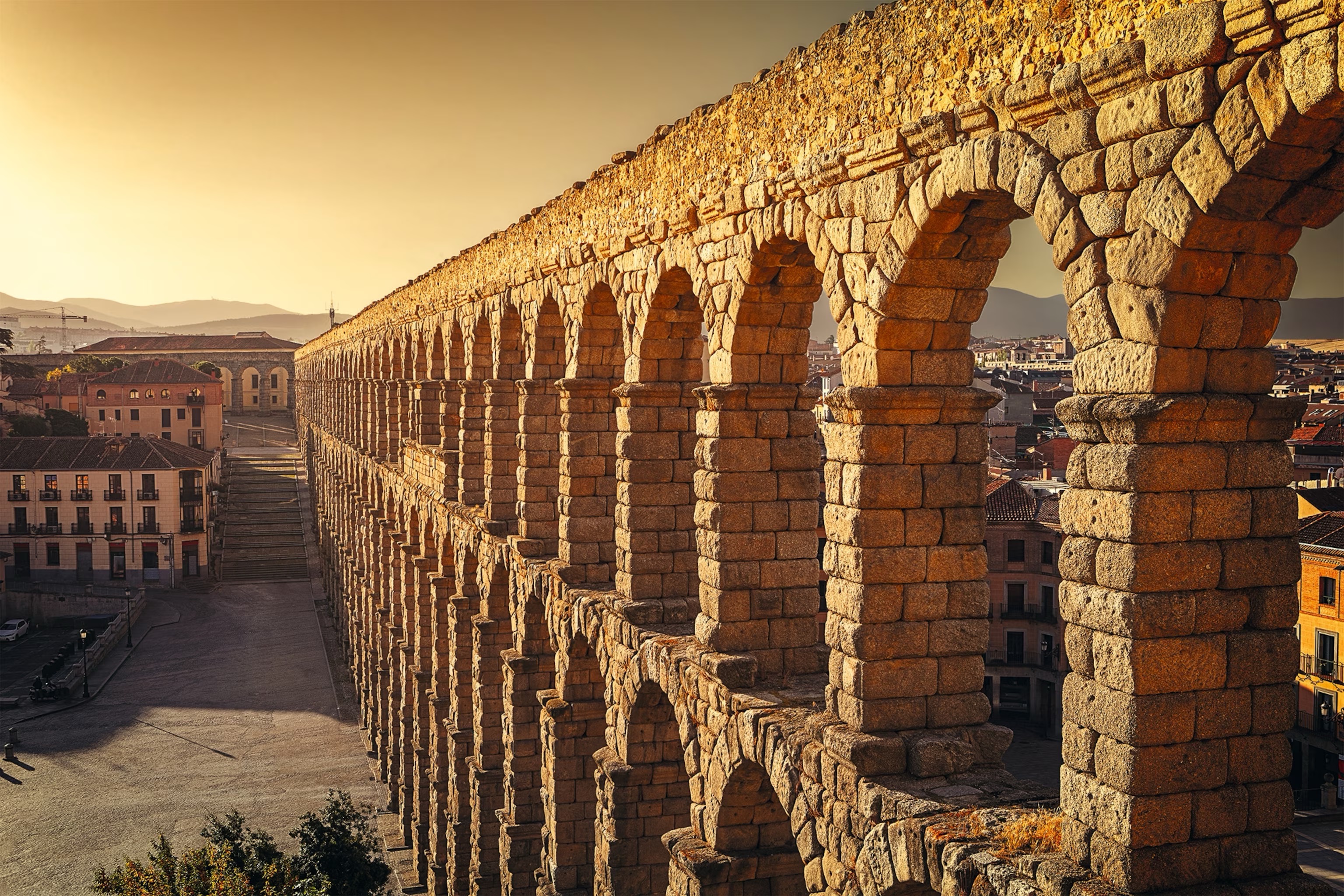
Another incredible innovation of the Romans was the aqueducts, a means to transport water from one location to another. This not only allowed water to be moved from a spring or river to a fountain or bath, but also supplied farms and major cities with adequate and (relatively) safe water. Aqueducts, a word derived from the Latin aqua meaning water and ductus, meaning to be guided, were not a Roman invention, as we see water systems like it appearing across the globe, but are greatly attributed to the Romans due to their massive infrastructure that, when put all together, totaled around 258 miles (415 km). First appearing in the Roman Republic in 312BCE, aqueducts moved water across Rome and soon began being built across Italy, the Middle East, North Africa, France, and the Iberian Peninsula, well into the Imperial period.
Aqueducts moved water across all kinds of terrain and into public and private structures with relative ease. Using gravity and inverted siphons, the Romans moved water from the source through lead pipes or conduits of ceramic, concrete, stone, and brick to different places. Tunnels and arched bridges helped move water through lowlands, maintaining pressure to keep the flow moving, and sometimes the water was cleaned through sediment tanks and filters to remove debris. One of the most famous aqueducts still standing today is the Pont du Gard in southern France, which served Roman Gaul and carried water to Nîmes (previously known as Nemausus). With its two-tier arches of limestone, constructed in the first century CE (around 40-60CE), this aqueduct continued to provide water into the 1700s.
The architectural and engineering creativity of Ancient Rome continues to astound and inspire all who have had the chance to see it, whether it be in person, online, or on the pages of a textbook. The roads, aqueducts, and Colosseum, though in a more primitive state today than in their heyday, survive as a powerful reminder of this ancient civilization’s capacity for innovation and construction, as well as the breadth of Rome’s reach and ingenuity.
References:
“The Colosseum.” Parco archeologico del Colosseo, https://colosseo.it/en/area/colosseo/.
“Roads in Roman Britain.” English Heritage, https://www.english-heritage.org.uk/learn/story-of-england/romans/roman-roads/.
“Pont du Gard (Roman Aqueduct).” UNESCO World Heritage Centre, https://whc.unesco.org/en/list/344/.