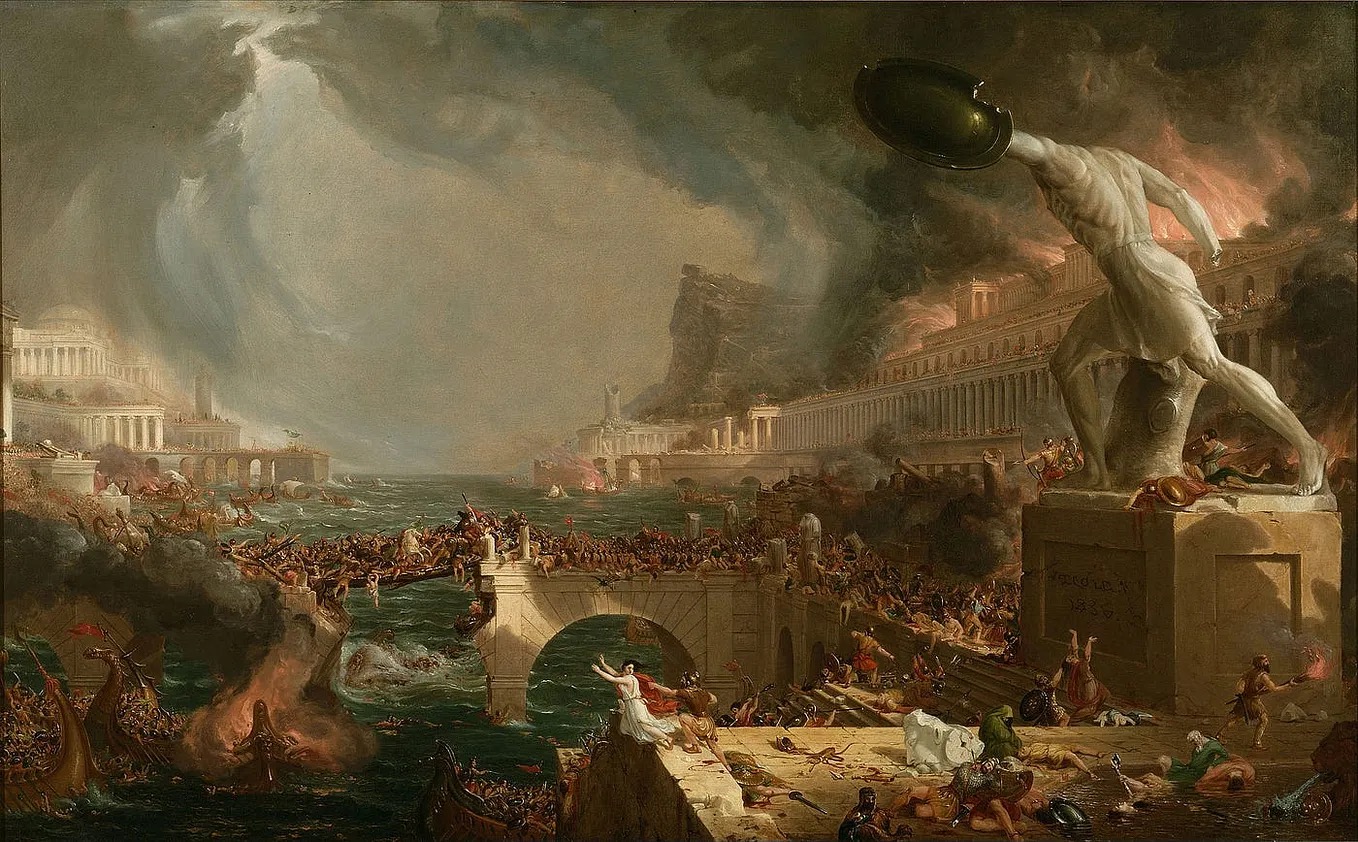
By its end, Rome was no longer a small city-state. Conquests brought immense plunder and a tidal wave of slaves. Vast latifundia replaced peasant farms, using slave labor to produce commodities such as olive oil and wine. Vast disparities in wealth produced increasing social unrest, spawning violent political conflicts that ultimately brought about the fall of the Republic.
Rome’s legions had originally been a militia comprised of small farmers called up by the consuls. After campaigns, the soldiers returned to their farms to harvest their crops. As campaigns became longer and took place farther from Rome, the old military system no longer worked.
A crucial date is 133 BCE. The tribune Tiberius Gracchus used his veto power to bring the government to a standstill, forcing it to grant land to the poor. The Senate declared a state of emergency, leading to his assassination and the murder of hundreds of his followers. A decade later, his brother Gaius Gracchus was elected tribune. Gaius called for granting land to the poor and creating courts to try corrupt senators. The Senate reacted with fury, assassinating him in 121 BCE and murdering many of his followers.
Two contending groups emerged: the populares, who advocated social change benefiting the poor, and the optimates, who saw themselves as defending traditional Roman values. Each side jockeyed for control of Rome. Then, in 112 BCE, the African leader Jugurtha defeated Roman armies. Gaul faced an invasion by Germanic tribes, the Cimbri and Teutones, who killed more than 50,000 Roman troops at the Battle of Arausio in 105 BCE. Facing disaster, General Gaius Marius was granted dictatorial powers, and he used them well, decisively defeating the Germanic invaders and then defeating and capturing Jugurtha. Marius supported the populares. He solved the acute army manpower shortage by recruiting the landless, promising land and payments when soldiers retired. This marks the point when Roman soldiers began to show loyalty to charismatic commanders rather than the Roman state. The Senate managed to oust Marius, who went into political eclipse for a time, emerging again in 87 to seize power.
Many Italian allies revolted from 90 to 88 BCE in what became known as the Social War. This conflict marked the emergence of another towering figure, Lucius Cornelius Sulla. He defeated the rebels and was then sent to Anatolia, where a war ignited that threatened Roman rule. Sulla won the war but was troubled by the rise of Marius and his seizure of power in Rome. Sulla and his army returned to Italy and defeated Marius in a short civil war.
Sulla took control of Rome, forcing the Senate to grant him dictatorial powers. A backer of the optimates, he hunted down those who had supported Marius. Thousands were executed, and their property was seized and sold. Sulla thought of himself as a restorer of the Republic and retired in 79 BCE. In 78 BCE, the consul Marcus Aemilius Lepidus advocated restoring the powers of the tribunes that Sulla had removed. The Senate condemned him, and he raised an army to march on Rome. He was defeated by a rising politician, Gnaeus Pompeius, known as Pompey the Great.
Violence and rebellion continued to shake the Roman Republic. From 77 to 71 BCE, a former supporter of Marius led a rebellion in Spain, forcing Rome to send Pompey to suppress it. In 73 BCE, an even greater crisis erupted when the gladiator Spartacus led a massive slave revolt across Italy. Marcus Licinius Crassus was granted extraordinary powers to crush the uprising, defeating the rebels and crucifying thousands of survivors along the Appian Way. In 67–66 BCE, Pompey received sweeping authority over the Mediterranean to eliminate the Cilician pirates before being sent east to defeat the persistent Mithridates VI.
Meanwhile, political turmoil gripped Rome itself. As consul in 63 BCE, Marcus Tullius Cicero uncovered a conspiracy led by the aristocrat Lucius Sergius Catilina to seize power. Cicero, already renowned as a statesman, writer, and orator, helped defeat the conspiracy, and Catiline was ultimately killed in battle. Yet as one crisis ended, another figure was quietly rising through Roman politics—an ambitious young aristocrat named Gaius Julius Caesar.
In 60 BCE, Caesar, Pompey, and Crassus agreed to work together and formed the First Triumvirate, taking control of the Roman world. Caesar was given a highly unusual ten-year command over Gaul and, in a series of epic wars, conquered it. Crassus left Rome in 55 BCE for Syria, where he was killed when the Parthians, a Persian dynasty, annihilated a Roman army at Carrhae. In 49 BCE, the Senate ordered Caesar to give up his command and return to Rome. He refused and marched his army into Italy, rapidly taking control. Pompey resisted but was defeated at the Battle of Pharsalus in Greece. Pompey fled to Egypt, where he was murdered.
Caesar defeated several opponents in Spain and North Africa and supported Cleopatra VII in her attempt to gain the Egyptian throne. In 45 BCE, Caesar was appointed dictator for a ten-year period and soon had himself declared dictator for life, dictator perpetuo. At this point, members of the Senate, led by Marcus Junius Brutus, plotted to kill him and did so in 44 BCE, on the famous Ides of March.
One of Caesar’s commanders, Mark Antony, gave a fiery funeral oration and achieved great recognition. Caesar’s will named the young Gaius Octavian as his heir. Octavian was Caesar’s great-nephew, whom he had adopted as his son. Octavian then took the name Gaius Julius Caesar. Mark Antony defeated Brutus and the other assassins at the Battle of Philippi in Greece, where Brutus was killed. Meanwhile, Octavian defeated Sextus Pompey, the son of Pompey the Great, who had attempted to take control of Rome.
In 42 BCE, Octavian, Mark Antony, and Marcus Aemilius Lepidus, son of the former rebel, formed the Second Triumvirate. Unlike the first, this was a legal arrangement called the tresviri rei publicae constituendae. Octavian soon ousted Lepidus, and the empire was divided between him in the West and Mark Antony in the East. Antony began one of the great romances of history with Cleopatra VII and gave Roman territory to her family. Octavian seized on this and attacked Antony for betraying traditional Roman values. In 31 BCE came the Battle of Actium, again in Greece, which Octavian won. Antony and Cleopatra fled to Egypt. Octavian invaded Egypt, and both Antony and Cleopatra killed themselves. Octavian then ordered Cleopatra’s son killed and annexed Egypt.
Octavian achieved uncontested rule over the entire Roman Empire. In 27 BCE, the Senate conferred upon him the honorary title Augustus, by which he is known in history. Octavian, now Augustus, consolidated his power and ruled until 14 CE, one of the few men of his kind to die peacefully of old age.
None of these warlords thought of themselves as establishing an empire. They saw themselves as restoring the Roman Republic. Augustus called himself the “first citizen,” avoiding imperial titles.
Remnants of that time are still with us. In 44 BCE, the month of Quintilis was renamed July after Julius Caesar, and in 8 BCE, the month of Sextilis was renamed August after Augustus. Those two months, July and August, still peer at you from the calendar on the kitchen wall.
Bibliography:
Jacob Morato. “Praecipitia in Ruinam: The Demise of the Small Farmer and the Fall of the Roman Republic.” Saber and Scroll Journal, 5 (4), 2016.
Christopher Klein. “How Julius Caesar’s Assassination Triggered the Fall of the Roman Republic.” History.com. https://www.history.com/articles/julius-caesar-assassination-fall-roman-republic/
OpenStax, “The Roman Republic.” World History, Volume 1. Updated April 23, 2026.