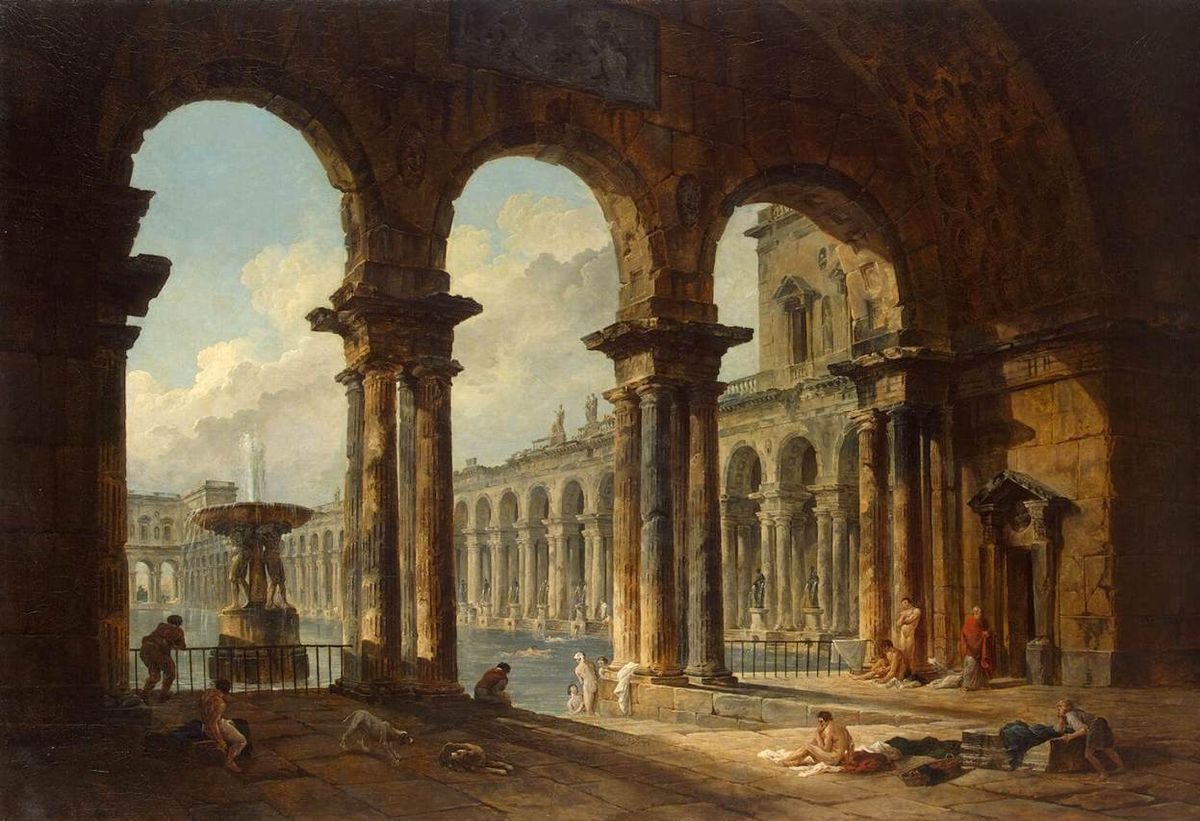
In today’s modern world, if you wish to find good conversation and a game, you might go to a bar or pub. In ancient Rome, it was all about the public baths. Thermae were public bathhouses where the residents of the Roman Empire would strip naked and relax, sharing the waters with friends and strangers alike. The public bathhouse served an important role in the daily lives of Ancient Romans as it was a luxury available to all, regardless of wealth or station. It offered a range of experiences and opportunities to socialize and relax from sunrise to sunset for a few denarii, though it was free on certain days. Both men and women were allowed to use the bathhouse at different times, and it provided a safe place to unwind, talk, and connect with others.
Across the empire, thermae stood as grand structures and were among the most impressive public buildings in Roman cities. Emperors often built them to gain popularity with the people. The Baths of Caracalla and the Baths of Diocletian were enormous, decorated with marble floors, towering columns, and beautiful mosaics. They could accommodate many bathers at a time. The Baths of Diocletian could serve three thousand visitors at a time, and Trajan’s Baths of Rome could at times reach eight thousand visitors a day. The most famous baths were located in Bath, Somerset, England, and remain among the best preserved bathhouse structures from the 1st century CE, adjacent to a temple in the former Roman settlement of Aquae Sulis.
Thermae or balnea frequently featured saunas, massage parlors, cool pools, a gym, private bathing areas for cleaning, gardens, libraries, and lecture halls for talks on a variety of topics. Vendors sold food, drinks, and other goods, giving visitors the chance to spend time and money at the bathhouse and have their respective needs met.
The apodyterium was the ancient equivalent of a modern-day locker room where bathers could disrobe and leave their personal belongings. This made it a popular place for thieves, and petty theft was common. Once the bathers had disrobed, they would then sojourn to the palaestra, or gymnasium, to exercise. Romans believed sweating before bathing was healthy. People played ball games, wrestled, stretched, or simply strolled around pretending to be athletic. It was a bit like the modern gym, except everyone knew half the crowd was really there to socialize. After working up a sweat in the gym, Romans would swim in the natatio, an open-air swimming pool, then proceed to the laconica, a heated dry room, and the sudatoria, a sauna-style sweating room. Next, bathers would enter the caldarium, where they would take the plunge into heated waters warmed by the hypocaust, an underfloor piped-water system heated by a wood-fired furnace—think hot tub, ancient Roman edition. Languid and relaxed, they would move to the tepid, lukewarm waters of the tepidarium before finally taking a cold plunge into the aptly named frigidarium. This would often be followed by a professional massage by a masso or aliptes, using scented oils such as lavender or myrrh. The oil helped remove dirt and grime, which they then scraped away with a strigil, a metal scraper. Completed, these steps would be repeated in reverse order before donning one’s clothes once more, ready to face the world refreshed.
Slaves and freemen alike worked at the baths, attending to the needs of bath visitors by bringing them towels, food, drinks, books, or other requests. They operated the fans that gently moved overhead, massaged clients, and carried olive oil to patrons, while others worked underground, feeding fuel to the wood furnace or pumping the water into the facility. Attendees at the baths could have their desires met without lifting a finger.
Bathing was a crucial aspect of Roman culture and self-care, and Romans viewed the practice of visiting a bathhouse as fundamental to preventing illness and warding off further disease or infection. Although the water and hygiene of the patrons were not always the best, as it was not filtered in the same way as is done today and was brought in through lead pipes, which was not the best way to avoid poisoning people, the baths were significantly better than jumping into a lake or river and far more social to relax. As the saying might go, mens sana in corpore sano—a healthy mind is a healthy body.
But hygiene was only part of the story. The bathhouse was also the place where social life happened. Politicians shook hands with voters. Merchants discussed business deals. Friends debated philosophy or argued about chariot races. If someone wanted to know what was happening in the city, the baths were the place to listen.
Writers from the time often complained about the noise. The philosopher Seneca once described the sounds coming from a nearby bathhouse: splashing water, shouting athletes, singing bathers, and the occasional slap from a massage. According to him, it was impossible to concentrate. Yet for most Romans, that lively atmosphere was exactly the point.
Bathhouses also reflected Roman values about public life. Romans believed that shared spaces strengthened the community. In the baths, people from different backgrounds could mix, though social divisions still existed. Wealthy citizens usually attended during quieter hours. By the afternoon and early evening, bathhouses were at their busiest. People relaxed, talked, and enjoyed the comfort of warm water and good company. It was the Roman version of unwinding after work, a combination of spa day, gym visit, and neighborhood café.
So were Roman baths about cleanliness or social networking? The answer is both. Romans certainly valued hygiene, but they valued community just as much. In a world without smartphones or group chats, the bathhouse served as Rome’s daily gathering place.
In other words, long before social media, Romans already knew how to stay connected—one bath at a time.
Bibliography:
Cartwright, Mark. “Roman Baths.” World History Encyclopedia. May 2nd, 2013.
Mowdy, Haley. “The History and Importance of the Roman Bath.” Texas Woman’s University.
Ward, Roy Bowen. “Women in Roman Baths.” The Harvard Theological Review vol. 85, no. 2
(1992): 125–147.