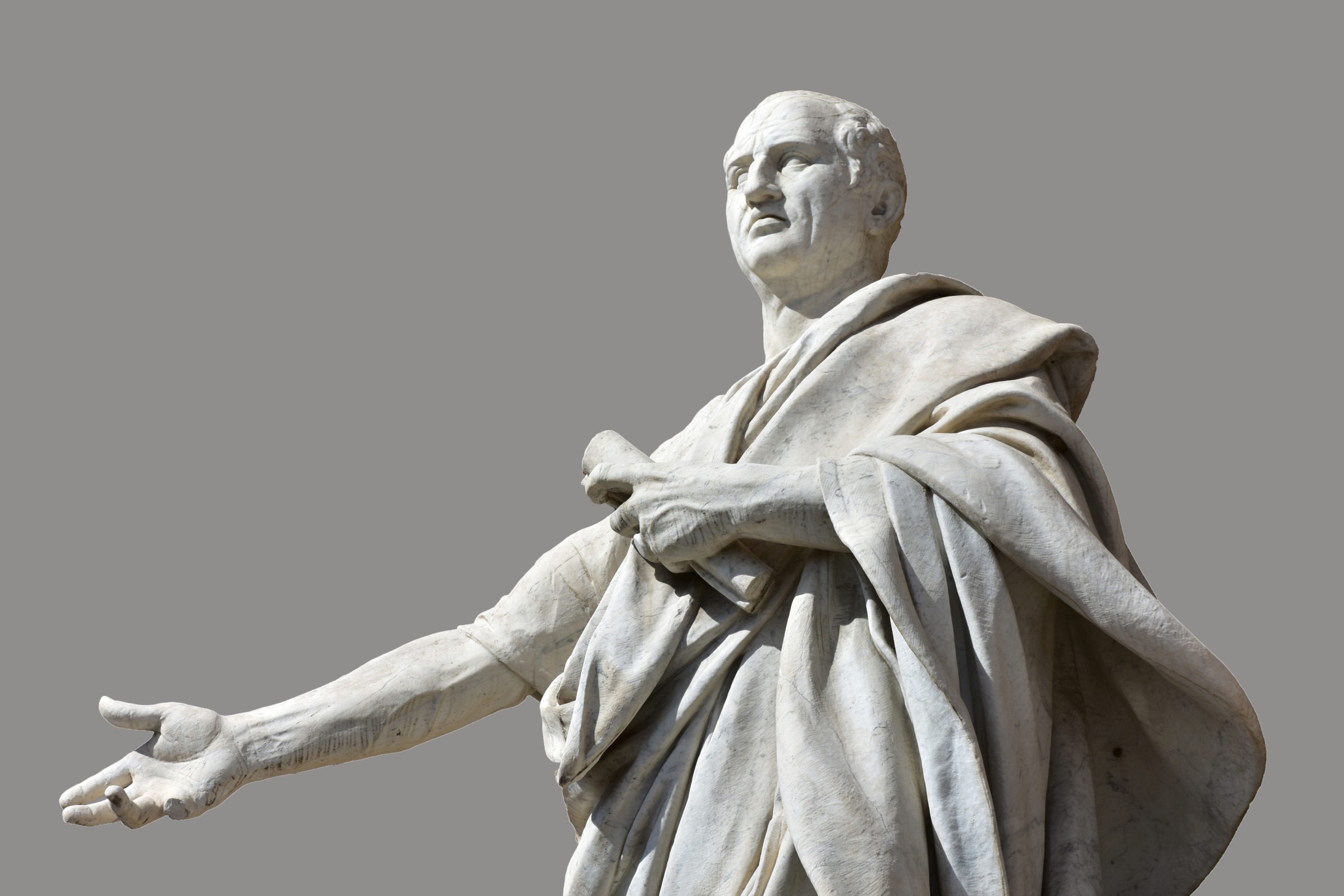
The Roman statesman Cicero is one of ancient Rome’s most influential figures, and it could be said that few had a lasting effect on Western rhetoric quite like him. Often considered Rome’s great orator, Cicero was much more than a gifted public speaker. He was a philosopher, lawyer, and true Republican who played a pivotal role in turning the art of persuasion into an intellectual tradition that later defined the Roman Empire.
Cicero was born sometime around January 3, 106 BCE, in Arpinum, a small town some 100 kilometers from the bustling city of Rome. Yet despite its distance from the beating heart of the Empire, it stood well within its immediate sphere of influence. Cicero's family belonged to the ordo equester (equestrian order), a prominent social class composed of wealthy landowners, business owners, and administrators. Even though Cicero's family possessed immense wealth, they lacked the ancient prestige and political influence that placed many of the city’s noble families in power. Therefore, his eventual pursuit of the highest political offices made him a novus homo, a title assigned to the first member of a family to attempt such a thing. But in a society where prestige was inherited through continuous generations of public service, this placed him at a significant disadvantage. Therefore, his advancement in Roman society would depend entirely upon his intellect, education, and eloquent nature.
Cicero’s family recognized he was gifted from a young age and sent him to Rome to receive the finest education money could buy. Once there, he studied Greek philosophy, rhetoric, literature, and Roman law under some of his generation's great minds, including Diodotus, Phaedrus, and Quintus Mucius Scaevola. As he became increasingly skilled across various subjects, it became obvious to him that eloquentia, or eloquence, could not exist without sapientia, or wisdom. This placed him firmly on the path to becoming, many consider, Rome's greatest orator. Cicero's potential and growing knowledge as a young adult were expressed in his De Inventione, a treatise on rhetoric. While he later regarded it as incomplete, it points to an idea he held throughout his life: that, to become a great orator, one must be intellectually disciplined, prepared, and ethically responsible. He firmly believed that rhetoric was so much more than a collection of verbal tricks; it was wisdom and eloquence working in union for the betterment of the Republic.
As he entered adulthood, Cicero's rigorous studies had prepared him for life in the competitive law courts of Rome, where his profound understanding of language established him as one of the Republic's most extraordinary advocates. This was the beginning of a career that would forever change the study of rhetoric. By the middle of the 1st century BCE, Cicero had emerged as one of the greatest statesmen, having risen through each of the traditional magistracies at an extraordinary rate. From quaestor to aedile, then praetor and finally consul, he achieved each of these titles at the youngest age permissible by law, a distinction often referred to as suo anno, meaning “In his own year.” In 63 BCE, he set into motion what would become the defining moment of his career. As consul, he exposed a conspiracy led by Lucius Sergius Catilina that aimed to assassinate prominent leaders and overthrow the Republic. Having previously accepted the Senatus Consultum Ultimum, this martial law decree gave him emergency powers, which he used to sentence five of the main conspirators to death without a trial. While many within the city praised him as a hero, others accused him of exceeding the limits of the law. This would come back to haunt him.
By 60 BCE, Rome had experienced another major political transformation with the emergence of the First Triumvirate, an alliance between the three powerful Roman figures: Julius Caesar, Pompey the Great, and Marcus Licinius Crassus. They used their combined financial and military power to concentrate power amongst themselves, essentially blocking the Senate. Caesar recognized how valuable Cicero's oratorical skills could be to his new arrangement and offered him a position within the coalition. Cicero, however, believed this threatened the very stability of the Republic and so refused to join them. His response set the stage for his exile, which came just two years later.
The tribune Publius Clodius Pulcher, who was a known ally of Caesar and the triumvirate, pushed through new legislation that effectively targeted Cicero for his previous decision to execute the Catilinarian conspirators without a formal trial. Knowing that standing trial would almost certainly mean death, Cicero fled Italy and settled in the ancient port of Thessalonica in Northern Greece. Roman officials later confiscated anything he had left behind, and his property was demolished, ultimately bringing what he thought was an end to his political life in Rome. But his exile wouldn't last forever.
Just eighteen months later he returned, yet by then his influence had waned significantly. In the civil war that followed, he decided to back Pompey, believing him to be the lesser threat to the mos maiorum, which had long defined Roman society. After Ceaser emerged victorious, Cicero accepted a pardon and mostly withdrew from political life to focus on his writings. During this period, he produced some of his greatest works, including De Re Publica and De Officiis. In these writings, he laid out his blueprint for the ideal statesman, which he argued must unite three key ideals: virtus (moral excellence), sapientia (wisdom), and eloquentia (eloquence). This vision would come to shape political thought for generations to come.
After Caesar met his tragic end on the Ides of March, Cicero believed this was the opportunity he had been waiting for. Almost immediately, he got to work in hopes of restoring the Republic, but first he had to deal with what he saw as the greatest threat to Rome's constitution: Mark Antony. Cicero briefly hoped this might restore the Republic he cherished so dearly. Although he took no part in planning Caesar's assassination, he passionately championed the cause before turning. He launched a series of fourteen orations known as the Philippics, employing the full use of his rhetorical talents to turn the public against Antony, portraying him as not only a tyrant, but an enemy of Rome.
Cicero also looked to Caesar's young heir, Octavian, as someone who could defeat Antony. Yet this turned out to be the most fatal mistake of his career. In time, Octavian joined forces with Antony and Lepidus to form the Second Triumvirate, and with that Cicero's fate was sealed. Antony called for Cicero's execution, and on December 7, 43 BCE, his soldiers overran Cicero's villa at Formiae and captured the orator. According to tradition, Cicero accepted death with the dignity often associated with Stoic philosophers. By Antony's orders, he was beheaded and his hands removed before being displayed upon the Rostra, which served as a stark warning to the rest of Rome. Yet even in death he continued to inspire the next generation, with his political philosophy and eloquentia shaping education and law, as well as Republican thought for centuries.
Bibliography
Everitt, Anthony. Cicero: The Life and Times of Rome's Greatest Politician. New York: Random House, 2001.
Steel, Catherine. Cicero. Oxford: Oxford University Press, 2001.
Powell, Jonathan G. F., ed. The Cambridge Companion to Cicero. Cambridge: Cambridge University Press, 2013.