The Roman Republic (509-27 BCE) is to this day the longest lasting republic in the history of the world. The United States has been independent only half as long. Although the Roman Republic died two thousand years ago, some of its basic governing principles still thrive: the separation of powers between the legislative and executive branches, term limits, a written code of laws, and the premise that no one is above the law.
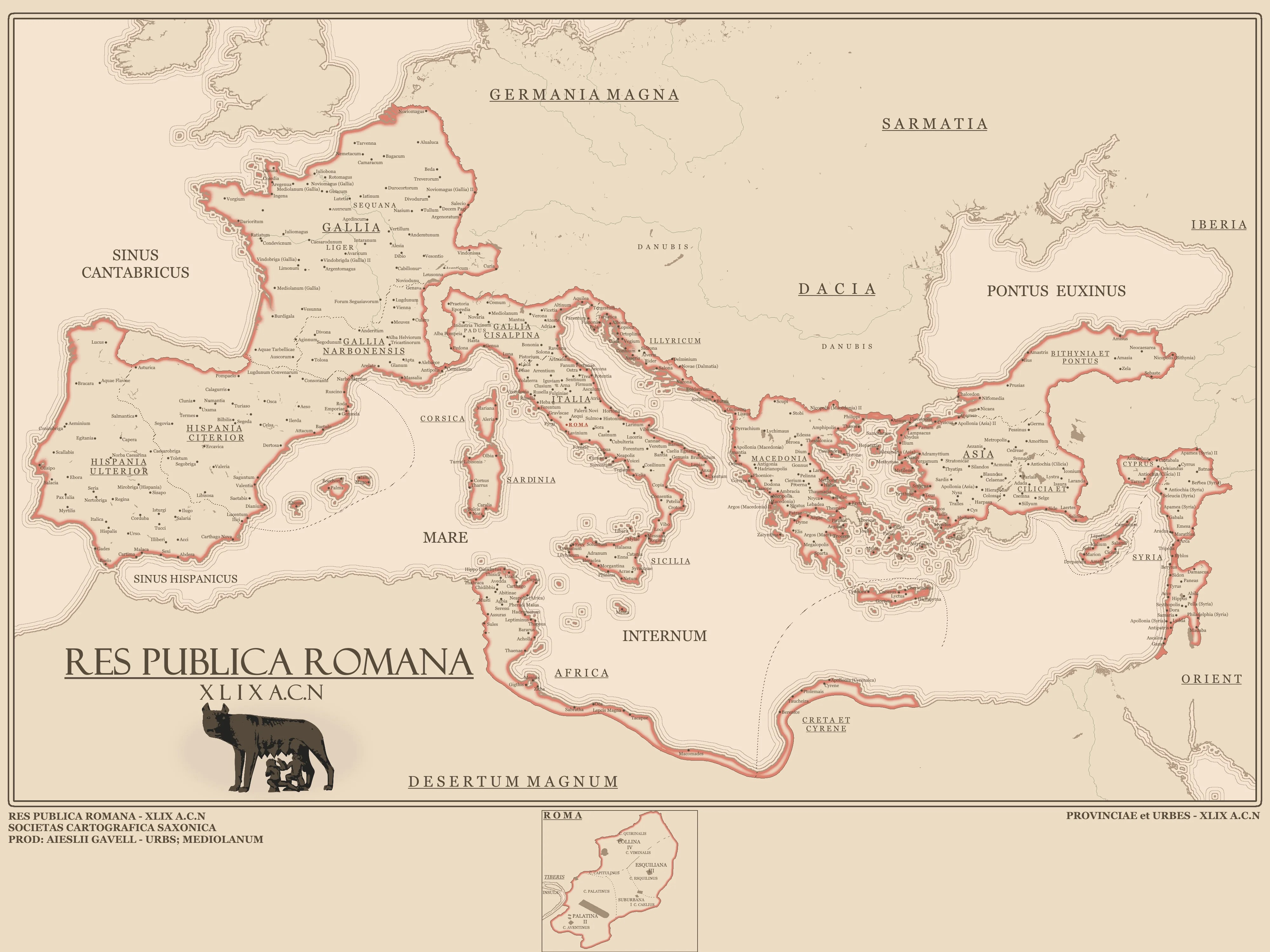
The Republic began as one of the small city-states in central Italy vying for precedence. The city itself held about 35,000 people, and the total population of the few hundred square miles Rome controlled was perhaps 100,000. Rome grew through war, annexation, and establishing alliances. By the end of the Republic, the city of Rome may have had several hundred thousand inhabitants, and its empire maybe 50 million. By then Rome controlled Italy, Greece, Spain, Gaul (most of modern France), Anatolia, and much of North Africa.
The basic political dynamic was the social tension between patricii and the plebeii. It was more complicated than the rich versus the poor. There were rich plebs and poor patricians. The strife between the two classes is usually called the Conflict of the Orders, and historians place it from 494 to 287 BCE.
In 494 BCE, the plebs, using the power of their numbers, went on a kind of general strike and set up the Plebian Council, concilium plebis, which created the office of tribune, tribuni. Tribunes held veto power over any actions or decrees by the Senate or consuls they thought might harm the plebs. The concilium plebis and tribuni gave the plebs appreciable political power for the first time.
In 454 BCE, the plebs went on strike again, demanding that the laws be written down, apparently because of ongoing abuse of the plebs in legal matters. A committee of ten, the decemvirs, was delegated to draft the laws. Composed in 451-450 BCE and ratified by the Centuriate Assembly in 449 BCE, they were engraved on twelve stone tablets called the Duodecim Tabularum, the Twelve Tables, and attached to the rostrum of the Roman Curia, the speaker’s platform outside the Senate; the curia was the building where the Senate met. The laws were available for all to see, and they formed a sort of Roman constitution. The laws specified many things, including banning intermarriage between plebs and patricians, stipulating that a father had life and death power over his sons, and that the dead could not be buried within the city limits. Rome had become a republic of laws.
Within a few years, Rome developed a sophisticated political system, although it continued to evolve throughout the Republic era (509–27 BCE). The Roman Republic’s government was a mixed constitution with three main branches: the Executive Magistrates, who led the state and military; the Senate, an advisory body of influential elites; and the Popular Assemblies, which comprised citizens who voted on laws and elections.
The Executive Magistrates included the consuls, two men elected for a single year who held supreme military and civil power, imperium, and could veto each other. After their terms, assemblies assessed consuls' actions, and they could be charged with crimes, which served as a serious check on their power. The second most powerful were praetors, elected annually, who handled judicial matters and sometimes substituted for consuls and served as military commanders; aediles, who managed Rome’s infrastructure, such as public works, food and water supplies, games and festivals, and city maintenance; quaestors, who oversaw finances; censors, who tracked the citizen list, property, public morality and could remove senators for misconduct; and a dictator, a single temporary leader granted absolute power for up to six months during severe military or domestic crises.
The Senate was composed of about 300 (later more) former magistrates and wealthy patricians who served for life. The Senate had few actual powers, but carried great prestige, and its advice, senatus consultum, to the magistrates was usually heeded. It held immense informal authority because of its members' high social status.
The Popular Assemblies included the Centuriate Assembly, Comitia Centuriata, which organized citizens into groups based on wealth; it declared war, ratified peace, and elected senior magistrates, including consuls. The Tribal Assembly, Comitia Tributa, organized by geographic tribes, handled civilian legislation, minor trials, and elected junior magistrates. The Plebeian Council, Concilium Plebis, was an assembly exclusively for plebs that elected tribunes who possessed the power to veto acts harming plebeians and passed laws, called plebiscites, applying only to plebs.
Citizens were male and recognized as adults between the ages of 15 and 18, symbolized by being allowed to wear the toga virilis, a toga worn by adult men. Roman society was firmly patriarchal; women held few rights and were under the guardianship of their fathers, brothers, or husbands.
As the Republic matured, ambitious Romans followed an established pathway of increasingly prestigious political offices known as the cursus honorum. The cursus began with quaestor (minimum age 25), then aedile (36), praetor (39), and consul (42). A former consul might become a censor. Previous military service was not always formally required, but tradition and, at certain periods, law made military experience an important prerequisite for political advancement.
One office existed only in times of national emergency. A consul or general could be appointed dictator, magister populi, for up to six months and was granted absolute powers. A dictator was expected to leave office once the emergency ended. Over the life of the Republic, there were about 80 dictators.
The office of dictator assumed the dictator would be public-minded and committed to the Republic, and most were. However, absolute power can tempt ambitious men to push beyond the traditional limits of office. In the decades around 100 BCE, Rome faced growing social unrest, political violence, and serious military crises. Amid this turmoil, the rival generals Gaius Marius and Lucius Cornelius Sulla became embroiled in a series of conflicts that erupted in civil war and brought extreme violence to Rome itself. Sulla ultimately emerged victorious and had himself appointed dictator, imposing his extraordinary authority to reshape the Roman government before voluntarily retiring from public life in 79 BCE.
In creating the office of dictator, the Republic had created the means of its own eventual destruction. Marius and Sulla were followed by other powerful generals whose armies increasingly became instruments of personal ambition. Decades of civil war and political upheaval eventually brought the Republic to an end and paved the way for Augustus and the rise of the Roman Empire.
One reason the governing system of the Roman Republic worked so well for almost five hundred years was that it split authority between the patricians and the plebeians, providing checks on power while remaining efficient. Another reason was that public service was considered an honor, and service to Rome took precedence over service to family. It is therefore no coincidence that the founders of another republic, 1,700 years later, chose to adopt much of the Republic’s constitutional system.
Bibliography:
John Matsusaka. The Democratic Institutions of the Roman Republic. Constitutional Political Economy, Springer Nature, April 22, 2026.
Donald Wasson. Roman Government. World History Encyclopedia, November 29, 2015.
Yale Law School. Lillian Goldman Law School Library, the Avalon Project, The Twelve Tables