The city of Rome started out as an ordinary settlement on the Italian peninsula, but with time, as the centuries passed, the citizens of Rome subjugated their neighbors to become the dominant city of Italy. Once masters of the peninsula, the Romans clashed with Carthage, and in a series of destructive wars, which are today remembered as the Punic Wars, the Roman Republic wore down the Carthaginian Empire to become the master of the western half of the Mediterranean Sea. The ambition of the Romans was not sated by their conquest of the western Mediterranean, and throughout the course of the second and first centuries BC, slowly but surely, the Romans conquered the Hellenic successor kingdoms of Alexander the Great.
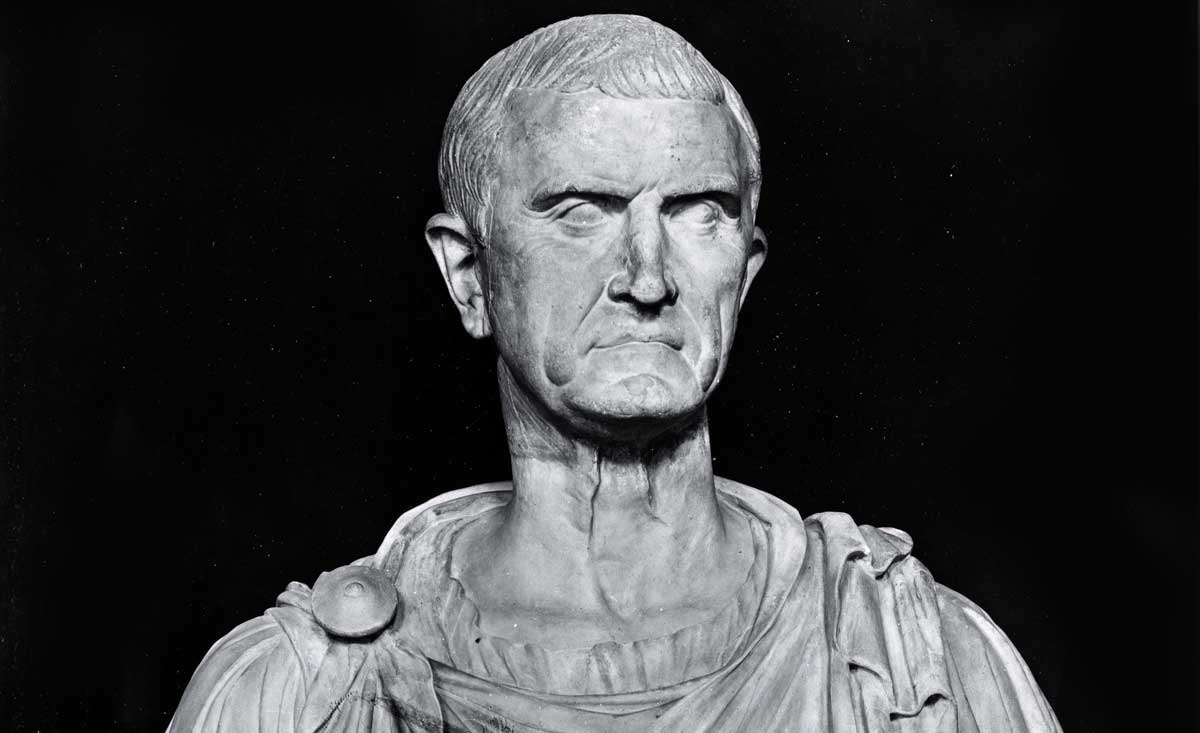
Many prominent generals rose in this period, and by the first century BC, the Roman Republic’s institutions had become much weakened, as ambitious generals and politicians became rich and influential enough to monopolize power in their hands. These ambitious figures soon clashed with one another, and civil wars devastated the Roman world. Republican government was reestablished after Sulla willingly abdicated his absolute power; nonetheless, with the deaths of the first generation—Marius and Sulla—arose another generation of ambitious generals. By the 50s BC, Roman politics were dominated by three men: Pompey the Great, Marcus Licinius Crassus, and Gaius Julius Caesar.
Crassus and Pompey both rose in the service of Sulla when they served under him in the civil war; however, the two figures did not like one another one bit. Crassus did the bulk of the fighting against the rebellious slaves of Spartacus and defeated the gladiator; however, a returning Pompey, recalled from Spain by the Senate, defeated some smaller groups of slaves and rushed to Rome to have himself celebrated. Crassus saw this as a personal insult and did not forget it for a decade. It was the wily Caesar who succeeded in reconciling them and promised to help them both if they, in turn, helped Caesar’s bid to become consul. The three men agreed, and thus was born the First Triumvirate.
When Caesar’s term as consul ended, his allies helped him become governor of the Roman provinces in southern Gaul, from where he began to conquer the rest of Gaul—without asking the Senate, of course. Caesar’s campaign in Gaul was unexpectedly successful, and he became both very rich, thanks to the loot he got from the conquest, and incredibly popular among the common people. Pompey was already very popular and an established military man, as before his alliance with Crassus and Caesar, he fought and conquered many lands in the eastern Mediterranean, defeated a rebellious general in Spain, and ended the threat from the Cilician pirates.
Crassus, on the other hand, despite his stupendous wealth, thanks to which he was known as the richest man in Rome, lacked the military successes of his allies, and many historians believe that he was becoming jealous. He was not an untested commander, as he fought during Sulla’s civil war and against Spartacus, but by 55 BC, a decade and a half had passed since Crassus’s last campaign. The three met in 56 BC and agreed to continue their alliance, as it served all of them. Using their influence, they got Caesar’s command in Gaul extended for another five years; Pompey received the provinces in Spain, while Crassus was named the governor of Syria. With their alliance renewed, Caesar returned to Gaul, Pompey chose to remain in Rome, while Crassus sailed off to Syria.
Crassus arrived in Syria in 55 BC and used his immense fortune to raise an army of some 35,000 to 40,000 soldiers. Without asking the permission of the Senate, Crassus decided to invade and conquer as much of the Parthian Empire as he could. His campaign against the Parthians began the next year, and he attacked western Mesopotamia and succeeded in conquering parts of the country. With his campaign successful, Crassus left behind garrisons and retreated to Syria to spend the winter there. During the winter, Publius, the son of Crassus, arrived with his cavalry from Gaul. Publius served under the command of Caesar and, by then, was regarded as a seasoned commander.
Crassus was approached by the King of Armenia, who offered to join the Roman invasion of Parthia if Crassus agreed to attack the Parthians from his kingdom. It was a generous offer, as the Armenians had around 30,000 to 40,000 soldiers, and their mountainous country was also suited to the Roman army, which was centered around heavy infantry, but Crassus rejected the offer and decided to continue the attack from Mesopotamia. The rejection of the Armenian king’s offer turned out to be a crucial mistake, as, on his own, the Armenian king was defeated by the Parthian king. While the ruler of Parthia was fighting in Armenia, he dispatched a great noble from the house of Suren to take the fight against Crassus. The Parthian noble sent some of his men to “aid” Crassus, pretending to desert to the Romans, but in reality, these men were leading Crassus to a prearranged place where the Parthians were waiting for them.
This place was on the flat desert ground not far away from the town of Carrhae, prime ground for a cavalry-heavy army like that of the Parthians. Crassus’s army greatly outnumbered the Parthian force—40,000 to 10,000; however, the Parthians had more cavalry and were much more mobile than the Romans. Most of the Parthian army was made up of horse archers, but they also had a contingent of heavy cavalry. Upon first contact, Crassus’s subordinates wanted to deploy their force into the traditional formation, with infantry in the center and cavalry on the wings, but Crassus changed his mind and ordered his men to deploy into a giant square so they could not be flanked.
At first, the Parthian horse archers circled around the Romans and released volleys of arrows into them; then, the heavy cavalry charged, only to be beaten back. Crassus’s strategy was a defensive one, as he wanted to remain on the defensive until the Parthians ran out of arrows, but the Parthian general had thought about this possibility and brought thousands of camels with his army, carrying a large supply of arrows.
The Romans were horrified when they found this out, and Crassus sent out his skirmishers first and later his cavalry, under his son Publius, to drive away the horse archers. Both attempts failed, and the Roman cavalry was lured into an ambush where they were killed. To deal another psychological blow to the Romans, the Parthians rode close to the Roman lines, bringing the dead Publius’s head on a spear. The one-sided battle continued until night fell, and the Romans, under the cover of darkness, retreated to Carrhae. The Roman soldiers were shocked and close to mutiny, with his officers forcing Crassus to go to a parley offered by the Parthians.
Crassus was reluctant, but seeing the mood of his soldiers, he went to the parley, where, under unknown circumstances, he and his entourage were killed. According to one popular version of the events, the parley was only a ruse, and the Parthians slaughtered the Romans, captured Crassus, and killed him by pouring molten gold down his throat. Another version of the story is less dramatic, and according to this one, fighting broke out after a misunderstanding, though the result was the same: the Roman party and Crassus were killed by the Parthians.
The remnants of the Roman army were led back to Syria by Gaius Cassius Longinus, who later became known for taking part in the assassination of Caesar. The battle was a crushing defeat for the Romans, who lost nearly half their men killed and a quarter captured, and the defeat remained a great shame and humiliation for the Romans for many decades.
Bibliography:
Cassius Dio. Roman History, Volume III: Books 36–40. Translated by Earnest Cary, Harvard University Press, 1914.
Plutarch. “The Life of Crassus.” Plutarch’s Lives, Volume III, translated by Bernadotte Perrin, Harvard University Press, 1916. University of Chicago.
Sampson, Gareth C. The Defeat of Rome: Crassus, Carrhae, and the Invasion of the East. Pen & Sword Military, 2008. Bryn Mawr Classical Review.
Ward, Allen Mason. Marcus Crassus and the Late Roman Republic. University of Missouri Press, 1977. Google Books.