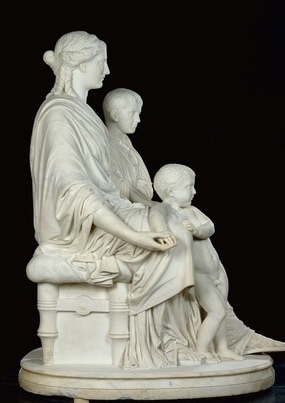
Familial legacy in Ancient Rome was essential to establishing one’s place, as a name carried incredible weight and power and could guarantee opportunities otherwise elusive to the majority of the population. Marrying a notable individual could give the resulting children a chance at a prosperous life. Being born into a significant lineage, particularly one of prestige and wealth, could mean the difference between survival and prominence in the upper echelons of Roman culture. In other words, nepotism was the key to success!
During the age of the Roman Republic, two notable families, the Gracchi and the Africani, stood at the pinnacle of Roman society, and one woman was able to establish herself as a bridge between the two: Cornelia Africana. Her legacy remains one of the most fascinating and significant of the Roman Republic. Her two sons, Tiberius and Gaius, exposed the deep flaws of the state and helped set in motion its eventual collapse. In many ways, Cornelia Africana was the most influential woman of the Roman Republic, and she would become a key figure in ancient history.
Cornelia Africana was the second daughter of Aemilia Tertia Paulla, a consul’s daughter, and Publius Cornelius Scipio Africanus, a wealthy and esteemed commander of the Roman Republic whose victory against the Carthaginian general Hannibal in 202 BCE at the Battle of Zama brought about the end of the Second Punic War. The Africani family belonged to the patrician class, the privileged elite. The patricians were a minority compared to the masses of ordinary people, or plebeians, who made up the majority of the Roman Republic’s population.
At around seventeen, in 173 BCE, Cornelia married the significantly older Tiberius Sempronius Gracchus, a prestigious general, consul, and statesman who had previously been a close ally of her father. Despite the age difference, Cornelia and Gracchus were happily married and clearly enjoyed one another intimately, as evidenced by the birth of twelve children, six of each sex, although only two of the boys and one girl survived to adulthood.
Aside from the tragic deaths of nine of her children, Cornelia’s husband passed away at the height of their union in 154 BCE, leaving her alone to raise their children in turbulent and patriarchal Rome. Her wealth and celebrity, however, allowed her some wiggle room and sovereignty, a luxury rarely afforded to her fellow women at the time. Instead of remarrying, as was expected and customary for well-off, high-society widows, Cornelia dedicated herself to her children and her life in the Republic, even turning down a proposal from Pharaoh Ptolemy VIII, who promised to give her the wealth of Egypt in exchange for her hand in marriage. Instead, Cornelia turned her focus to her children, providing for and overseeing their education while ensuring that her own independence, as well as her wealth and place in society, was retained and protected.
To many, she became a symbol of respect and feminine bravery, devoting her time to studying Greek, literature, philosophy, rhetoric, and Latin. Not only did she maintain her own sovereignty and a desire to be “more than just a mother”, but she also became well known for her mastery of language and her writing. Under Cornelia’s tutelage, and thanks to her influential place in Roman society, her sons Gaius and Tiberius met many of the great thinkers, orators, politicians, and philosophers of the period, who, in turn, helped introduce the boys to a variety of ideals, values, and policies that challenged the fabric of their class.
When the boys came of age, they joined the military. As they were nine years apart in age, Gaius watched his brother’s rise before pursuing his own path. Tiberius served in the Third Punic War and the Numantine War before entering the cursus honorum, or ladder of offices that made up the public political structure, where he served as treasury auditor, or quaestor. He became a popular figure among the plebeians and moved up the political ranks before returning to Rome to serve on the Concilium Plebis, or Plebeian Council. He was elected in 133 BCE to serve as tribunus plebis, or tribune of the plebs. Tiberius became a beacon of reform, particularly through the leges agrariae, laws and policies governing the distribution and use of public lands, and the protection of farmers’ rights. Tiberius sought to do more for the Roman people and made many enemies among his own caste. During his reelection bid, his opponents, led by his cousin Publius Cornelius Scipio Nasica, launched an attack, and Tiberius and hundreds of his supporters were beaten to death.
In 132 BCE, a year after Tiberius’s murder, Gaius, much to Cornelia’s chagrin, came to prominence after serving with distinction in Spain and Sicily in the army. Afterward, he began a quiet political career, serving as quaestor in Sardinia before he was elected tribune in 123 BCE. While in office, he introduced two laws: one that banned ousted officials from holding another political office, and a second that did not allow for capital trials without Assembly approval. Gaius also reaffirmed the laws his brother had introduced and enacted new policies that benefited the people. He turned his focus to corruption in public office, which added fuel to the fire against him, and he ultimately failed to be reelected.
His greatest opponent, Lucius Opimius, was elected consul in 121 BCE and strongly opposed his reforms. Tensions between Gaius’s supporters and opponents turned violent. The Senate passed the senatus consultum ultimum, an emergency decree that gave Lucius Opimius extraordinary power to defend the Republic. Gaius and his supporters gathered on the Aventine Hill, where negotiations failed, and Opimius sent armed forces against them. Gaius fled across the Pons Sublicius, but when he realized that escape was impossible, he reportedly ordered an enslaved attendant to kill him. His head was brought to Opimius, while his body and those of thousands of his supporters were thrown into the Tiber.
The Gracchi brothers challenged Roman law, especially regarding corruption and land distribution. Their work and policies influenced countless politicians and reshaped much of Roman Republican politics. Political violence became far more common, and orators became subject to vicious and uncivil discourse. This contributed to the Republic's decline and the rise of the dictator Gaius Julius Caesar, who also met a violent end. This, in turn, contributed to the end of the Republic and the start of the Empire under Octavian, or Augustus Caesar.
Although Cornelia did not always agree with her sons’ political choices, she remained devoted to them and was deeply affected by their violent deaths. After Gaius’s death, she withdrew to Misenum, where she spent the remaining years of her life away from the political turmoil of Rome. Yet her influence did not disappear with her sons. Cornelia remained widely admired for her intelligence, independence, education, and devotion to her family. By the time of her death around 100 BCE, she had become far more than simply the mother of the Gracchi. She had established a legacy of her own, one that made Cornelia Africana one of the most respected and influential women of the Roman Republic.
References:
Aly, Samuel. “The Gracchi and the Era of Grain Reform in Ancient Rome.” Tenor of Our Times vol. 6 no. 6 (2017) pgs. 10-22. Harding University.
Plutarch. “Gaius Gracchus.” Translated by Bernadotte Perrin. Cambridge: Harvard University Press, 1921.
Wasson, Donald L. “Gracchi Brothers.” World History Encyclopedia. August 14th, 2023.