The heart of Ancient Rome, through its years as a Kingdom, Republic, and Empire, was built upon the labor of enslaved people and, in many ways, could not have functioned without them. Men, women, and children from across Europe, Africa, and the Middle East were captured, sold, or born into servitude, becoming part of a system that touched nearly every aspect of Roman life. Life as a slave in Rome was difficult and horrible for many, but for a few, it was a means to an end and an opportunity to gain their freedom and, perhaps, become a citizen of Rome one day.
Slavery, or dominium (the Roman legal term to mean absolute ownership of property), was an essential part of Ancient Rome’s culture. Slaves came from across the realm, having been captured, conquered, convicted of a crime, sold by family to pay off debt, or simply unfortunate to have been born into their station. Markets across the Roman state boasted an array of human chattel for sale, and for a sum of denari or Roman silver coins, a slave could be purchased.
Slaves were a vital commodity in Rome, and they made up a huge proportion of the Roman populace. According to statistical data, it is estimated that during the Roman Empire, one in three on the Italian peninsula was enslaved. At the same time, one in five across the entire dominion was part of the slave class, or somewhere between 10% and 30% of the entire population.
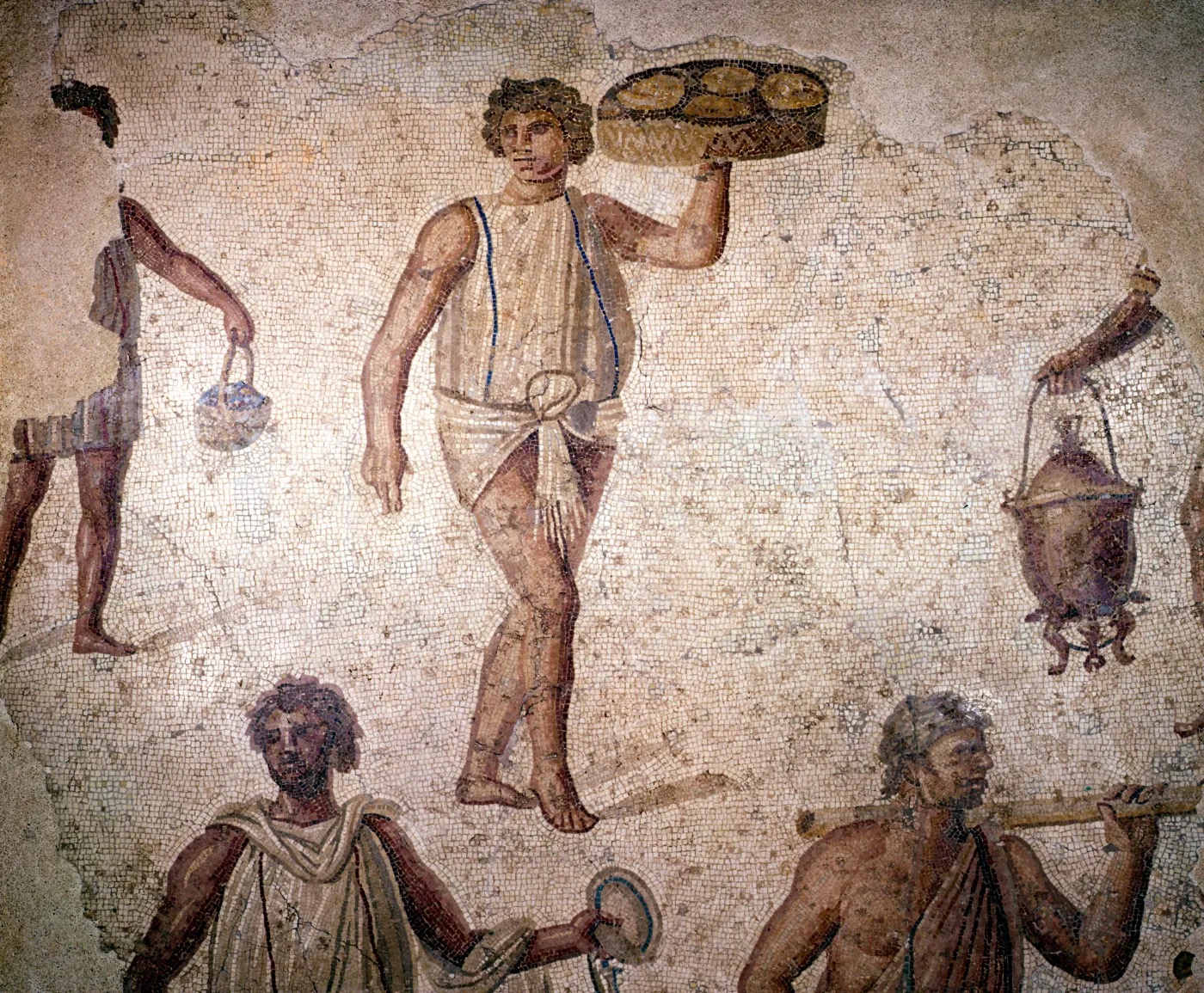
Slaves were the invisible but ever-present workforce in Rome, serving in a vast number of different professions. Some slaves toiled away in brutal conditions, chained together in an array of mines or general construction, building roads, homes, or other architectural jobs. Some served as seasonal workers and bounced from job to job as required by their masters or their industries. Others worked for the military as porters or camp aides on dockyards or onboard ships, while many worked in the fields on farms and estates. Some slaves operated as personal servants for their dominus or domina (master or mistress), helping them dress and bathe, while others worked in the home as cooks, cleaners, nannies, educators, and general caretakers. A good number of slaves worked for businesses, serving food or caring for customers at bathhouses or inns, and served in transport, carrying litters or driving carriages.
Specialized skills also played a vitally important role for enslaved people in Roman society, whether they had already developed expertise before enslavement or were later trained by their masters. A healer captured after the conquest of a village in Gaul, for example, might be purchased by a physician and made to assist in treating patients or accompany his master on medical rounds. Likewise, an enslaved person with talent in mathematics or literacy could work as an accountant for his master's business or serve as a tutor within a wealthy household. Others, such as horsemen, would be taken to ride chariots in races, and warriors who had been forced to surrender to the might of the Roman army might be purchased by a gladiatorial school or ludus, and trained to participate in brutal tournaments for the entertainment of the crowds.
Slaves who worked in private residences were given quarters and a relatively comfortable existence but were subject to the abuses and demands of their masters. Seasonal workers and farm slaves resided in barracks, or ergastulas, which were infamous for their terrible, frequently overcrowded conditions with scarce access to food and general care. Work was soul-crushing and body-destroying, and slaves did all they could to try and survive, while others decided to rebel, some quietly, others in more obvious ways. Some slaves stole money or food; others subtly took part in some of the small pleasures that they could, even if it was a risk. There are many cases of slaves who ran away, some of whom managed to escape, but others were recaptured and killed or branded and tortured for their insolence.
The most famous Roman slave revolt took place in Capua in the 1st century BCE, led by Spartacus, a Thracian gladiator who freed between 70,000 and 120,000 slaves across the Republic. His army shockingly defeated Roman legions and two Consuls before being destroyed in Gaul in 71 BCE under Marcus Licinius Crassus. Over 6,000 rebel slaves were captured and crucified to warn other slaves of similar ideas.
One unusual feature of Roman slavery was the possibility of freedom. Many enslaved people hoped for Manumission, the legal act of being freed. A master might free a loyal slave after many years of service, or a slave might even save money to buy their own freedom. Gladiators and charioteers could earn their freedom through a series of successes in their respective sports and make their way in the world. Once freed, they became liberti or freedmen. Freedmen were not completely equal to free-born Romans, but they could work, own property, and build successful lives.
Despite these possibilities, we should not forget the basic reality that slavery was built on control and inequality. Millions of people lived their lives without freedom, and their labor helped build the Roman economy, cities, and infrastructure. Behind every grand Roman villa or marble temple were countless individuals whose names history rarely recorded. The Romans might have called them servi, but they were human beings with hopes, fears, and dreams, just like the people walking through Rome’s crowded streets today, two thousand years later.
As the Romans themselves might say, sic transit gloria mundi, “thus passes the glory of the world.” Even the greatest empires are built on the lives of ordinary people.
Bibliography:
Cartwright, Mark. “Slavery in the Roman World.” World History Encyclopedia. November 1st, 2013.
Madden, John. “Slavery in the Roman Empire: Numbers and Origins.” Classics Ireland vol. 3 (1996): pgs. 109–128.
Roth, Ulrike, Tajana Sadon, Pier Luigi Morbidoni. “The Roman Slave Community- Enslaved Life in the Ancient World: Britannia and Germania.” The University of Edinburgh. June 30th, 2019.