Toga! Toga! Toga! When one thinks of fashion in Ancient Rome, one thinks of the toga, a simple fabric draping off the shoulder of John Belushi chugging a beer in a frat house. In reality, Ancient Roman clothing was varied and more than a bed sheet haphazardly thrown on; instead, it incorporated an array of accessories, materials, and styles that highlighted the diversity of the Roman Republic and Empire.
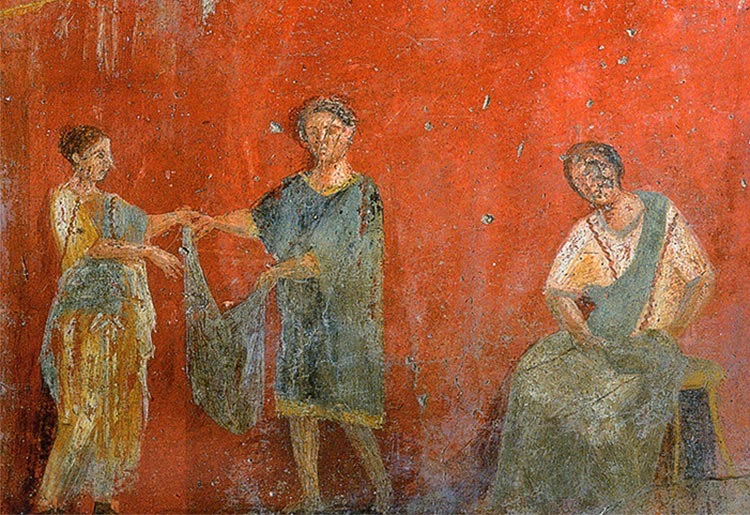
Men in Rome predominantly wore tunics, long shirts that could reach the knees or the middle of the thighs, and could be short-sleeved or sleeveless. Over the tunic, many Roman men wore a toga, a long, draping fabric that covered most of the body. Usually white and exclusively available to Roman citizens, togas could be used to distinguish the wearer’s class and were often reserved for social occasions. A thin red stripe meant the wearer belonged to the equestrian class, and a thicker, wider red stripe denoted belonging to the senatorial rank. Those of lower status would wear just the tunic, often the natural oatmeal color of flaxen, while those who could afford it could dye their clothing with a variety of pigments.
Women in Ancient Rome wore more loose-fitting, full-length dresses similar to the chiton or peplos; Greek-inspired dresses that often accentuated the arms, shoulders, or cleavage, but covered the whole body to the ankles. Married women wore a draping garment known as a stola, or a robe dress that covered the arms and shoulders. Some women wore veils or shoulder wraps. No woman of repute would wear a toga, as it would mean they were either an adulteress or a prostitute. Both men and women would wear a camisia, or a night tunic to bed.
Although it may be perceived that people in ancient times ran around without underwear, Roman men and women did wear undergarments. Men wore a loincloth or a subligaculum, which looked like boxer briefs. Gladiators wore the subligaculum, which was often the only piece of clothing they wore aside from their armor. A modern-day comparison would be MMA fighters wearing their combat shorts. A female version was also available. Women also wore a rudimentary bra, or a mamillare, a piece of leather or cloth that wrapped around or under the breasts to keep them covered or prevent them from drooping. Also, women were expected to be relatively flat-chested, as was the preference at the time, and binding the breasts with a mamillare helped keep things tight and compressed.
For cold weather, men wore cloaks that would either be draped over or pinned to the shoulder or to the front of the toga. Women, likewise, would wear a palla, or a woman’s cloak. Leg wraps or tibiale would cover the legs up to the thighs. Trousers were exclusively for men and were popular among non-Romans, especially in Central and Western Europe north of the Italian Peninsula. They were seen as barbaric, something no respectable Roman would be caught dead in, although they became standard wear in the late imperial period and were more accepted.
Linen and cotton were the most common materials used to make garments, although the wealthy could afford to import silks and other expensive cloth for their attire. Leather was used for armor or accents, such as belts, bracers, or shoes. Wool was perfect for winter dress and outerwear, and fur was also used to insulate or accent clothing. Animal coats were seen as luxurious and highly sought after by the wealthy. An example would be lion skin being worn by a commander who led his troops to victory in North Africa, while an officer of the auxiliaries who fought near the Rhine might wear wolf pelts or bear skins.
Pins and clasps were essential for bunching the clothing properly. Brooches, called fibulae, held a woman’s dress up at the shoulder, and men and women alike had their respective attire accented by a belt. Jewelry was crucial, from necklaces and earrings to ornaments. Men and women alike wore rings, but women also wore hairpins and headpieces as important distinguishing pieces of their outfits. Caligae, or sandals, were the standard footwear, usually made of leather but could also be made of wool, depending on the season or location.
For the Romans, clothing was a status symbol and an essential marker of class. Modesty mattered, but so did presentation. In that sense, their world doesn’t feel all that different from ours. Today, the toga lives on but mostly as a party costume, a simplified version of something that once carried real meaning. So the next time you hear “toga party,” it’s worth remembering that for the Romans, that same garment wasn’t a costume. It was a statement.
Bibliography:
Gill, N.S. “Ancient Greek and Roman Clothing.” ThoughtCo. Updated May 12th, 2025.
Gill, N.S. “Types of Ancient Roman and Greek Dresses for Women.” ThoughtCo. Updated May 7th, 2025.
Vout, Caroline. “The Myth of the Toga: Understanding the History of Roman Dress.” Greece & Rome vol. 43, no. 2 (1996): pgs. 204–220.