In Ancient Rome, before heading to work, school, or the marketplace, you might stop to pray at a small household shrine, leave an offering for the gods, or ask for protection for the day ahead. Maybe your father is worried about the family business, your mother wants a healthy harvest, and your brother is preparing for military service. In Rome, there was a god for all of it.
The Romans did not merely regard religion as a private system of beliefs. Religion was part of everyday life: politics, war, family, even dinner. The gods were everywhere. If crops failed, perhaps the gods were displeased. If Rome won a battle, the gods clearly approved. If lightning struck your roof? Well, Jupiter probably had something to say.
The Romans were very keen on maintaining Pax Deorum, or 'the peace of the gods'. The notion was that Rome would prosper only so long as the gods were duly honored with prayers and rites, with sacrifices and festivals. The Roman religion was almost a colossal exchange program. Humans respected the gods and the gods protected Rome in return.
Of course, keeping dozens of gods happy wasn’t exactly simple.
The Roman Pantheon was enormous. Jupiter ruled the heavens with thunderbolts in hand. Mars oversaw war and military strength. Venus represented beauty and love. Neptune controlled the seas, while Mercury sprinted around as the messenger god and protector of merchants. Janus, perhaps Rome’s most unusual god, had two faces and watched over beginnings and endings. Romans even named the month of January after him because he could symbolically look backward into the old year and forward into the new one.
The Romans borrowed many of these gods from the Greeks, though they gave them Roman names and slightly different personalities. Zeus became Jupiter, Aphrodite became Venus, and Ares transformed into Mars. Interestingly, the Romans admired Mars far more than the Greeks admired Ares. Since Rome’s identity was built on military success, Mars was viewed as disciplined and honorable rather than chaotic and violent.
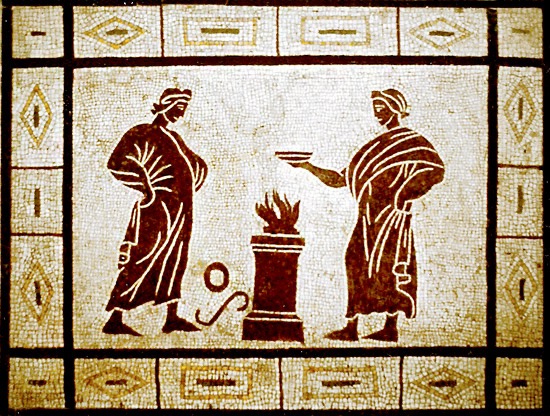
Religion was not confined to temples, but was also present in the homes of ordinary people. Many Roman families worshiped protective spirits of the household, called lares and penates. Little shrines were installed near the kitchen or the family area, where offerings of bread, wine, or incense were made. So while Jupiter may have ruled the sky, the lares made sure your house didn't spontaneously combust.
Public religious ceremonies were much more elaborate affairs. Priests in ornate robes made sacrifices at the temples while crowds gathered to watch. Bulls, sheep, or pigs were sacrificed in honor of the gods. Roman priests even read the entrails of sacrificial animals to interpret divine messages.
The Romans also thought that the gods communicated through signs, called omens. For example, you might see a crow flying a certain way or see something that has to do with a particular deity lying on your path. A person could then consult an augur or a priest, who would interpret these signs and tell him what they meant.
Rituals were to be done without incurring the ira deorum, or wrath of the gods. If you committed a vitium or error, for example, by making a mistake in a ritual, ignoring signs from the gods, or interrupting services, this could lead the divine spite to punish you for your shortcomings, such as making you sick or causing you to fail at what you were trying to accomplish.
The Roman calendar year was filled with religious festivals. One of the most famous was Saturnalia, a festival in honor of Saturn, the god of agriculture. Saturnalia was a time when the normal social rules were suspended. Masters became slaves. Gambling was allowed. People gave each other presents, and they ate and partied in the streets. Romans decorated their houses with greenery and celebrated loudly for days. Saturnalia was, in many ways, a bizarre mixture of Christmas, New Year’s, and a city-wide costume party.
Religion and politics were closely intertwined in Rome. Many important political leaders also held religious office. Julius Caesar, who became dictator, was pontifex maximus, the chief priest of Rome. Subsequent emperors exploited religion to reinforce their authority, and many were deified after death. Some emperors became so self-confident in their greatness that they encouraged divine worship while still alive.
As the Roman Empire expanded across Europe, Africa, and the Middle East, Roman religion continued to adapt, grow, and diversify. Eventually, though, a new religion began to spread quietly through the empire: Christianity. The Roman authorities were very suspicious because Christians refused to worship the Roman gods or to honor the emperor as divine. To many Romans, this rejection threatened pax deorum itself. Christians were persecuted from time to time, but the religion continued to grow rapidly.
By the 4th century CE, Emperor Constantine had embraced Christianity, and Roman history and religion would never be the same. Christianity eventually became the dominant religion of the empire, and the temples of Jupiter, Mars, and Venus slowly lost their relevance.
Yet Roman religion never quite faded. Its many myths, gods, and symbols continue to influence the modern world. The planets are named after Roman gods. Government buildings are constructed like Roman temples. Books, movies, and video games keep retelling Rome's myths. The Roman gods no longer receive sacrifices of wine and cattle, but their stories still inform the modern world.
Bibliography:
“The Cambridge Companion to Ancient Mediterranean Religions.” Ed. Barbette Stanley Spaeth. Cambridge: Cambridge University Press, 2013.
Carper, Virginia. “The Bedrock of Roman Polytheism: Pax Deorum.” Divine Multiplicity: A Multi-Trad Polytheist Community. 2019.
Champion, Craige B. “The Peace of the Gods: Elite Religious Practice in the Middle Roman Republic.” Princeton: Princeton University Press, 2017.