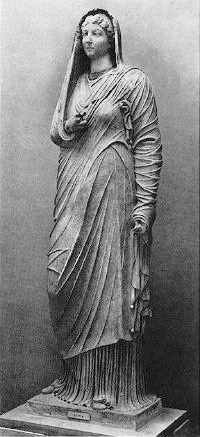
As the saying goes, “Behind every great man is a great woman,” and sometimes, that woman is more cunning, ambitious, and ruthless than expected, as she helps her male counterpart become a powerful and impressive leader. In ancient Rome, as the Republic permanently shifted toward an imperial system, Livia Drusilla emerged as one of the most influential and powerful women in Roman history, helping her husband, Augustus Caesar, become one of Rome’s strongest and most consequential emperors. Livia Drusilla’s legacy remains one of the most intriguing aspects of the early Roman Empire, showing that women could be not only great assets in their husbands’ ascents to power but also major players in establishing an empire.
Little is known about Livia Drusilla before adulthood, other than that she was most likely born in Rome on January 30 in either 59 or 58 BCE (a lady never reveals her true age). She was born into the notable Claudian family, one of the most prominent and powerful families of the Roman Republic, which held tremendous sway within the Senate and the Roman military. Drusilla married her first husband and cousin, Tiberius Claudius Nero, and had two children with him: Tiberius Nero and Nero Claudius Drusus.
While pregnant with Drusus, Drusilla divorced her first husband and married Gaius Octavius (Octavian), the adopted son and chosen heir of Julius Caesar, in 38 BCE. The marriage benefited both Octavian and Drusilla, forging a lasting connection between the influential, wealthy, and formidable Claudian and Julian families. As a beautiful, intelligent, and noble woman, Drusilla earned praise and admiration from the Roman elite and populace alike, becoming a valuable ally in Octavian’s ascent to power.
To many, Drusilla held considerable sway over her husband and aided him in his political dealings, with Octavian seeking her advice on matters such as showing clemency toward his political enemies. Others, such as the historian Tacitus, portrayed her as a calculating manipulator who influenced Octavian in his pursuit of greater power over the Roman state. As Octavian reestablished control and order in Rome, he became Rome’s first emperor in 27 BCE, taking the name Augustus and ruling as the state’s preeminent political authority.
Drusilla stood by her husband as his right hand, overseeing their household and private estate on the Palatine Hill (there wasn’t exactly a palace there yet, obviously). As Rome’s first lady, Drusilla enjoyed freedoms that most Roman women at the time could scarcely have dreamed of, including considerable financial independence, legal privileges, and the security to move freely throughout the Empire. Quickly adapting to her position as Rome’s most powerful woman, she made it her life’s work to protect everything she had gained and to secure a future in which her children would stand next in line for imperial power.
Augustus’s first wife, Claudia, had only given him a daughter, Julia, so she was not a viable candidate to sit on the throne. Rome was a patriarchal society, and women were seen as subservient and ineligible to rule. Julia and her husband, Gaius Claudius Marcellus, had two daughters, Julia and Agrippina, and three sons, Gaius, Lucius, and Agrippa Postumus, making the grandsons next in line to rule Rome, as they were directly related to Augustus. As luck would have it, however, death befell Augustus’s lineage and gave Drusilla the means to secure a future for her eldest son.
Gaius and Lucius died as a result of wounds received in battle in 4 CE and of illness in 2 CE, respectively. After Augustus died in 14 CE (it was suspected that Drusilla may have had a hand in his demise), Drusilla delayed sharing the news of the emperor’s death to ensure that Tiberius Nero became emperor, preventing Agrippa, who was in exile, from seizing power. Tiberius took the throne shortly after his stepfather’s death and, soon after, ordered the exiled Agrippa to be executed, most likely under his mother’s instruction.
Drusilla’s ambition remained strong as she embraced the imperial cult, or cultus imperatorius, which deified the emperor. Drusilla was officially adopted by Augustus in his will, which allowed her to take the name Julia Augusta. Drusilla wielded her power deftly alongside her son, Emperor Tiberius, who became so frustrated with her oversight and interference that he exiled himself to the island of Capri to escape her (the ultimate helicopter mom!).
Even after her death at the age of 86 in 29 CE, Livia Drusilla’s influence did not disappear with her. Her descendants would dominate the imperial throne for decades: her son Tiberius succeeded Augustus, while her great-grandsons Caligula and Claudius would eventually become emperors, followed by Nero, her great-great-grandson by adoption. Yet Livia’s legacy extends far beyond the men who inherited the empire she helped shape. For more than half a century, she survived political upheaval, dynastic rivalries, and the transformation of Rome itself, emerging as one of the most formidable women of the ancient world. Ancient writers may have remembered her as a devoted wife, imperial matriarch, ruthless schemer—or some combination of all three—but one thing is difficult to dispute: Livia was never merely the great woman standing behind a great man. She stood beside him, helped build a dynasty, and left her own unmistakable mark on the history of Rome.
References:
Bullman, Greta. “Livia: A Portrait of Power and Influence in Ancient Rome.” Classics for All. December 11th, 2023.
Grether, Gertrude. “Livia and the Roman Imperial Cult.” The American Journal of Philology vol. 67, no. 3 (1946): pgs. 222–252.
Wasson, Donald L. “Livia Drusilla.” World History Encyclopedia. May 13th, 2016.