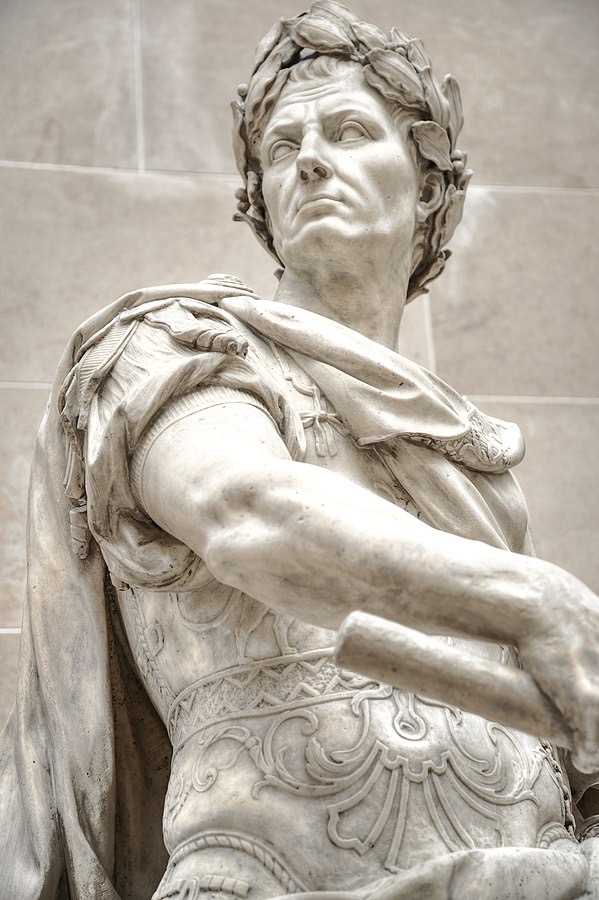
Julius Caesar won battles on three continents, survived being captured by pirates, dallied with one of the most famous women in history, Cleopatra, and became Rome’s ruler in all but name. His reform of the Roman calendar was used for 1,500 years. He could be ruthless, and he could be forgiving, pardoning many, including the man who led the conspiracy that murdered him. His tumultuous life is a fascinating story.
Gaius Julius Caesar was born in 100 BCE. His family was aristocratic, long on status and short on money. The family claimed descent from the god Venus via the Trojan hero Aeneas. Caesar was still in his teens when his father died. Around this time, he was nominated to become Flamen Dialis, the prestigious priesthood of Jupiter, and married Cornelia, daughter of the powerful Roman politician Lucius Cornelius Cinna. These connections placed the young Caesar in a dangerous position when Sulla seized control of Rome in 82 BCE and began eliminating his political enemies.
Sulla ordered Caesar to divorce Cornelia, but Caesar refused. His defiance came at considerable cost: he lost his priesthood, Cornelia’s dowry, and part of his family inheritance and was forced into hiding. According to Suetonius, Caesar moved from one hiding place to another, at one point bribing Sulla’s agents to escape capture. Influential relatives and the Vestal Virgins eventually persuaded Sulla to spare him. Caesar survived, but his refusal to abandon Cornelia offered an early glimpse of the determination and independence that would later define his political career.
An early indication of Caesar’s extraordinary self-confidence and resolve came around 75 BCE, when he was captured by Cilician pirates while sailing across the Aegean Sea. When his captors demanded a ransom of twenty talents of silver, Caesar reportedly laughed at the sum, declaring that they did not realize whom they had captured, and insisted that they demand fifty talents instead. During his thirty-eight days in captivity, he treated the pirates less like captors than companions, joining in their exercises, reading them his poetry and speeches, and repeatedly joking that, once freed, he would return and have them crucified. The pirates dismissed his threats as youthful bravado.
Caesar, however, kept his word. Once the ransom was paid and he was released, he quickly raised a naval force, pursued the pirates, and captured most of them. He had them all crucified, but gave them the mercy of having their throats cut first so they would not suffer the slow death of crucifixion.
Caesar returned to Rome about 74 BCE. He sponsored public entertainments and lived a lavish lifestyle, with the intention to gain followers and enlarge his reputation. He spent his fortune and went heavily into debt.
Another increasingly powerful figure at the time was Pompey. In 66-62 BCE, he defeated the formidable Pontic king Mithridates VI and reorganized Rome’s territories in the eastern Mediterranean, greatly expanding Rome’s Asian provinces. The new territories and tribute substantially increased Roman revenues.
In 61-60 BCE, Caesar became governor of Baetica (modern Andalusia in Spain) and conquered most of Spain. Plutarch, the Roman historian, tells the story that while in Spain, Caesar read the history of Alexander the Great and was seen weeping. He was upset that by the same age, Alexander had already conquered a huge empire.
After serving in Spain, Caesar returned to Rome with greater military prestige and renewed wealth. He formed an informal political alliance with Crassus and Pompey. Caesar was the skilled political operator, Crassus the wealthiest man in Rome, and Pompey its most celebrated general. Together they formed what historians call the First Triumvirate. Caesar became consul in 59 BCE and repeatedly clashed with conservative senators, particularly Cato the Younger.
In 58 BCE, he was appointed by a manipulated Senate to a four-year term as governor of the province of Gaul. Gaul was the region of Caesar’s greatest and most difficult wars. He greatly enlarged the province. He built a bridge across the Rhine and marched into Germany to awe the Germanic tribes. He faced several rebellions, the most formidable of which was led by Vercingetorix, who managed to unite most of the Gallic tribes and nearly drove Rome out. Caesar eventually won through hard fighting and brutal tactics. Of the perhaps six million people in Gaul at the time, perhaps a third were killed or enslaved. Caesar also invaded Britain twice, although neither lasted. He wrote Commentarii de Bello Gallico, Commentaries on the Gallic Wars, which was widely circulated at the time.
Caesar’s command in Gaul was extended after a conference with Crassus and Pompey in 56 BCE renewed their informal political alliance. The First Triumvirate began to unravel soon afterward and effectively collapsed in 53 BCE, when Crassus was killed and his army decisively defeated by the Parthians at the Battle of Carrhae.
The critical moment came in 49 BCE, when the Senate ordered Caesar to surrender his command and return to Rome as a private citizen. Without the legal protection of office, he risked prosecution for actions taken during his consulship. Caesar refused and led his army into Italy, crossing the Rubicon and beginning civil war. Tradition has it that Caesar said alea iacta est, meaning the die has been cast (a reference to gambling with dice).
Pompey fled to Greece, where Caesar pursued him and defeated his forces at the bloody Battle of Pharsalus in 48 BCE. Pompey then fled to Egypt, where agents of the young king Ptolemy XIII murdered him upon arrival. When Caesar reached Egypt, he was presented with Pompey’s severed head. Ancient sources report that Caesar reacted with horror and grief, and several of those responsible were later punished or killed.
Egypt was then undergoing a succession crisis between the teenage Ptolemy XIII and his older sister, Cleopatra VII. Caesar intervened in Cleopatra’s favor, and the two began an affair. Ptolemy’s supporters rebelled, besieging Caesar and Cleopatra in the palace in Alexandria for months. When reinforcements arrived in early 47 BCE, Caesar attacked Ptolemy’s force and crushed it. Ptolemy XIII drowned in the Nile.
Caesar then left Egypt to deal with a resurgence in Pontus, led by Pharnaces, son of Mithridates, whom he defeated. His last battle was in 45 BCE in Spain, where he defeated Gnaeus Pompeius, Pompey’s son, at the battle of Munda. Caesar was nearly defeated, but his luck held.
Caesar returned to Italy, master of Rome. He installed Cleopatra and her son Caesarion (who Cleopatra claimed was Caesar’s son) in a mansion on the Tiber. After his lifetime of struggles and victories, he settled in as Rome’s dictator. He was quite popular, funding many public works and assigning lands to demobilized troops. His reform of the Roman calendar meant that the year 46 BCE had 445 days; the Julian calendar dominated Europe until the Gregorian calendar reform in the 1500s. Caesar enlarged the Senate from 600 to 900, and increased the number of aediles, praetors, and other magistrate positions. He also began to recruit Senators from Roman territory outside Italy, which riled many in the Senate. In 46 BCE, he became dictator perpetuo, dictator for life. He became increasingly autocratic, wearing a purple robe and placing a throne in the Senate.
A faction in the Senate decided that killing Caesar could restore the old Republic. On March 15, 44 BCE, a group of Senators headed by Marcus Junius Brutus and Gaius Cassius Longinus attacked Caesar and stabbed him to death. So ended a most remarkable life.
More than 2,000 years after his assassination, Julius Caesar still looms large. Much of his legend is simply an accretion, like barnacles on a ship. There is zero evidence that he was born by Cesarean section, although that procedure is named after him. His last words, “you too, Brutus?” were written by Shakespeare in 1599. For centuries, the Russian rulers were called tsars, derived from Caesar, as were the kaisers, rulers of Hohenzollern Germany and Habsburg Austria. A month in the modern calendar, July, is named for him.
Bibliography:
Owen Jarus. “Julius Caesar: Biography, Facts and History.” LiveScience.com. March 28, 2022.
John Lendering. “Gaius Julius Caesar.” Livius.org. 1992, updated 2020.
Joshua Mark. “Julius Caesar.” World History Encyclopedia.org, April 28, 2011.