In the Roman Republic, women may not have been allowed to partake in the government, but it did not always keep them out of it, at least not entirely, and their role often pertained to aiding their husbands in achieving their aspirations. Fulvia, a notable noblewoman, played a significant part in her husband Mark Antony’s political career. She became the focal point of blame for political and civil mayhem in the late stages of the Roman Republic.
Before we delve into Fulvia’s life, it is important to know what it was like in the last century of the Roman Republic. Following the mob related deaths of the Gracchi brothers Tiberius and Gaius in 133 BCE and 121 BCE, respectively, Rome was teetering on the edge of uncertainty, predominantly due to the civic unrest and violence that became a desperate normality. The Republic’s army was at its strongest and had several major victories, expanding its borders. At the same time, imperatores, or commanders, began amassing huge numbers of supporters among civilians and soldiers alike, who were more than happy to do whatever was necessary to secure superiority.
By 60 BCE, the authority of Rome’s Senate was being challenged by a powerful alliance known as the First Triumvirate (a three-person political body) between Gaius Julius Caesar, Gnaeus Pompeius Magnus (aka Pompey the Great), and Marcus Licinius Crassus, which gave them greater control over political matters in the Republic. Political dissension spread into everyday life, with an ever-present “us versus them” mentality in every avenue of politics. It became a major issue, and many were targeted by political enemies in violent attacks that seemed to erupt constantly. You will see why all of this is important in a moment.
Although the date of her birth is not explicitly known, Fulvia was born and raised in either Tusculum, her father’s hometown in the Alban Hills, or in the city of Rome itself. She was the only child of Marcus Fulvius Bambalio, a prominent nobleman, and Sempronia, the daughter of Gaius Sempronius Tuditanus, a consul of Rome and family member of the esteemed Sempronia gens. Seen as the last of both wealthy and prestigious families, she was considered highly valuable and sought after by suitors.
Around 62BCE, Fulvia first married Publius Clodius Pulcher, a politician and opponent of statesman and orator Marcus Tullius Cicero. Fulvia and Clodius had two children, Publius Claudius Pulcher and Claudia, and were incredibly close-knit as a family. Clodius controlled a large group of supporters, mainly plebeians, or ordinary people, who backed his politics, giving him a lot of say in the Senate and a host of enemies. In 52 BCE, about ten years after they were married, Clodius was in the election to serve in the office of praetor, or magistrate, when he was assassinated in the streets by his political rival, Titus Annius Milo.
In 51 BCE, about a year after her husband’s death and his killer’s exile, Fulvia married Caius Scribonius Curio, a commander, politician, and stalwart supporter of Caesar. Like Fulvia’s second husband, Caius Curio was a nobleman but highly regarded by the plebeians, and in 50 BCE he was elected tribune, or representative to the people. While Fulvia was either pregnant or had recently given birth to their son Gaius Scribonius Curio in 49 BCE, Caius was killed at the Battle of the Bagradas in Caesar’s civil war against Pompey.
Despite everything, Fulvia remained a vital part of Rome's nobility and was introduced to Marcus Antonius (aka Mark Antony), the Master of Horse (second in command under Caesar), and just what Fulvia had been looking for. The pair married between 47 BCE and 44 BCE, although rumors spread by Antony’s enemy Cicero said the two had been involved since 58 BCE. That same year, Fulvia gave birth to their first son, Marcus Antonius Antyllus, and four years later, in 43 BCE, she had Lullus Antonius.
Antony adopted Fulvia’s children as his own and led the investigation to uncover the assassins responsible for the murder of Julius Caesar in 44 BCE. Antony ingratiated himself with the public’s favor by supporting populist causes and formed the Second Triumvirate with Marcus Aemilius Lepidus and Gaius Octavius (Octavian), Caesar’s adopted great-nephew and heir. To ensure her family remained in strong standing, Fulvia arranged for her daughter by Pulcher, Claudia, to marry Octavian (who would become Rome’s first emperor, Augustus Caesar) in 42 BCE, establishing a strong link between Antony, Fulvia, and the Caesar line.
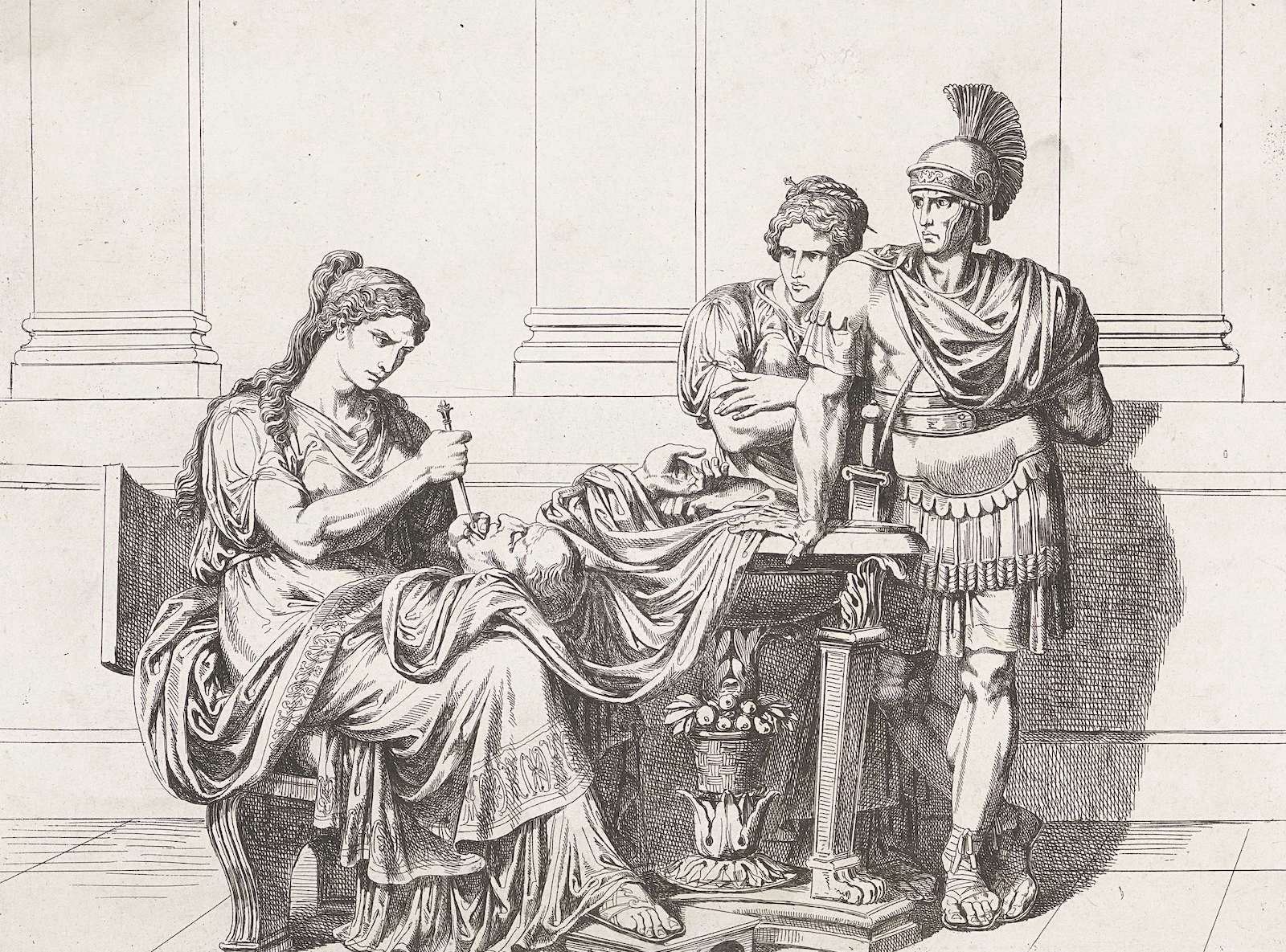
Fulvia became heavily involved in her husband’s career, defending her husband from his opponents’ attacks and staying in Rome while Antony hunted two of Caesar’s assassins, Gaius Cassius Longinus and Marcus Junius Brutus. She became entrenched in the political scene of Rome post-Caesar, managing Antony’s administrative and personal affairs while also overseeing policy and the political purges of enemies, or proscriptions. To many, she was the backbone behind Antony, who, while successful in hunting down the assassins, had other things on his mind than returning to his wife and family.
Despite Fulvia’s best efforts, Antony met and fell in love with Cleopatra VII, the Queen of Egypt and former lover of Caesar; this broke Fulvia’s heart but not her ambition. As the Second Triumvirate divided the Republic amongst themselves, Octavian divorced Claudia in 41 BCE and accused Fulvia of trying to establish herself and Antony as the sole political body in Rome. The divisions between the Triumvirate came to a head, forcing Fulvia to appeal to Antony’s brother Lucius Antonius and other allies for help and support against Octavian, which in turn stoked unrest and launched a civil war (the Perusine War) in 41 BCE. Antony was too busy sleeping with Cleopatra to notice.
Fulvia’s effort to keep power was fruitless, and Octavian’s propaganda campaign against her successfully blamed Fulvia for all the problems the Romans faced during the civil war. Fulvia’s forces were defeated in 40 BCE; she and her children fled to Greece while her brother-in-law was captured but ultimately spared by Octavian. Fulvia met with Antony in Athens, who viciously criticized her for her behavior and for interfering with politics over the last couple of years. Fulvia was said to be broken by her grief and, following a brief illness, passed away in 40 BCE. Antony and Octavian, meanwhile, reconciled and buried the hatchet (and Fulvia), cementing their alliance through Antony’s marriage to Octavian’s sister, Octavia the Younger.
Fulvia’s story reveals both the possibilities and the perils facing politically ambitious women in the late Roman Republic. Denied any official position of her own, she nevertheless exercised influence through marriages, alliances, family connections, and eventually military resistance. Yet when Rome descended into chaos, Fulvia became a convenient scapegoat: condemned for wielding the very power that men around her pursued openly and violently. She did not cause the fall of the Republic, but she became entangled in its final convulsions, and after her death, the men who had fought through her were able to reconcile over her grave. Fulvia’s life thus leaves us with a striking irony: Roman women may have been excluded from government, but they were never entirely absent from politics—or from the history written by the men who blamed them for it.
References:
Babcock, Charles L. “The Early Career of Fulvia.” The American Journal of Philology vol. 86, no. 1 (1965): pgs. 1–32.
Huzar, Eleanor G. “Mark Antony: Marriages vs. Careers.” The Classical Journal vol. 81, no. 2 (1985): pgs. 97–111.
Welch, Kathryn E. “Antony, Fulvia, and the Ghost of Clodius in 47 B. C.” Greece & Rome vol. 42, no. 2 (1995): pgs. 182–201.