From its legendary founding in 753 BCE, Rome was ruled by a succession of seven kings. The last was Lucius Tarquinius Superbus, who reigned for 25 years until his overthrow led to the establishment of the Roman Republic in 509 BCE. The Superbus in his name does not mean “superb”; in Latin, it means “proud,” “haughty,” or “arrogant.”
Tarquin was a tyrant, though not in the modern sense of a totalitarian ruler. He was a king who maintained his power in an alliance with the plebs, the commoners. His overthrow was really an aristocratic coup d’etat, that gave rise to a Republic that lasted centuries. The Republic was born in blood and betrayal.
Tarquin, grandson of Lucius Tarquinius Priscus (Rome’s fifth king, r. 616–578 BCE), gained the throne through murder. With his future wife Tullia, the youngest daughter of Servius Tullius (Rome’s sixth king, r. 578–535 BCE), he plotted the assassination of her father in an audacious act of regicide.
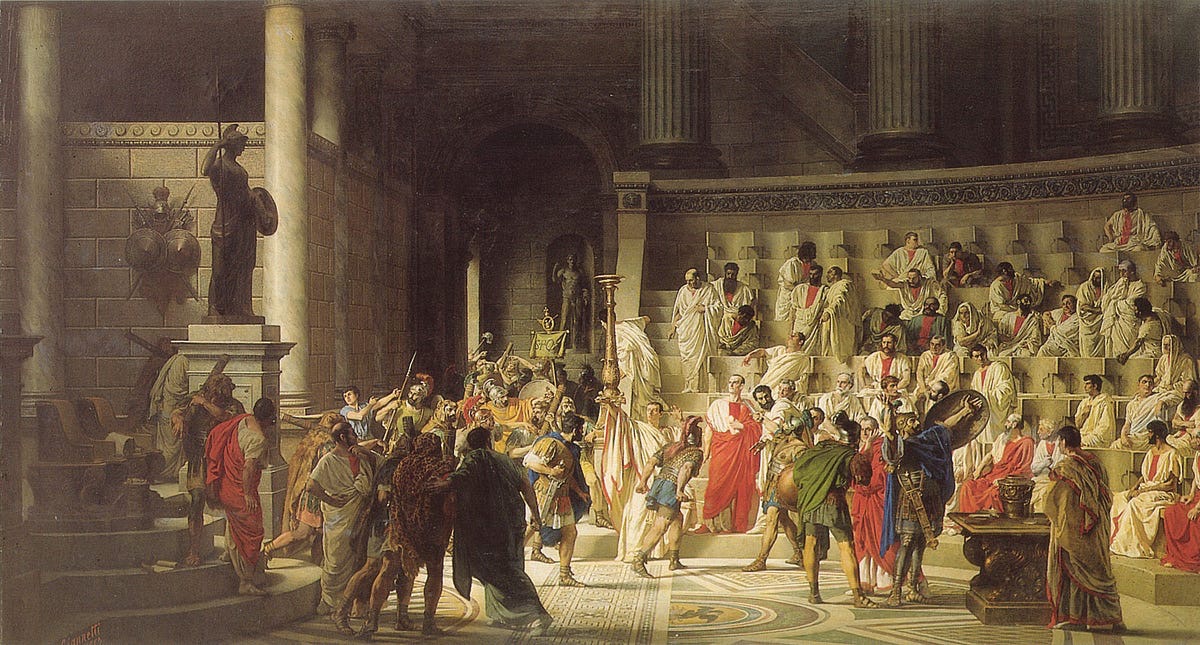
Tarquin boldly took the throne and summoned the Senate to recognize him as king. When Servius rushed to confront him, Tarquin had him thrown down the steps of the Curia Hostilia, the Senate’s meeting place. Servius fled but was pursued and murdered in the streets by Tarquin’s men. According to tradition, Tullia then drove her chariot over her father’s body, spattering herself with his blood. The brutality of the episode horrified the Roman aristocracy, and their relationship with Tarquin continued to decline over the next two decades.
Tarquin commenced his reign by refusing to bury the dead Servius, and then putting to death several leading senators, whom he suspected of remaining loyal to Servius. By not replacing the slain senators, and not consulting the senate on matters of government, he diminished both the size and the authority of the senate.
Tarquin was a formidable commander and diplomat who expanded Rome through both warfare and diplomacy. He signed Rome's first historical treaty with Carthage, suggesting that Rome had become a significant Italian power. With a population of roughly 35,000 and territory spanning several hundred square miles, Rome was unusually large in an Italy made up of smaller independent city-states. Tarquin also undertook major public works, including the expansion of the Cloaca Maxima, Rome’s great sewer and drainage system
Tarquin’s haughtiness seems to have been inherited by his sons. In 508 BCE, his second son Sextus became enamored of a married woman named Lucretia, and when she refused his advances, he raped her. She told her husband, Lucius Tarquinius Collatinus, about it and then killed herself in shame. This incident sparked a revolt. While Tarquin was on campaign, a group of Senators, led by Lucius Junius Brutus, took control of Rome. Brutus and others swore an oath never again to allow a king in Rome and resolved to execute anyone found aiding in restoring the monarchy. Tarquin returned from battle but was refused entry into the city.
After the monarchy fell, Brutus and Collatinus became Rome’s first consuls, originally called praetors. Brutus then ordered the confiscation of the Tarquin family’s property and their exile from Rome. Collatinus, who belonged to the Tarquin clan, was also asked to resign. After his elderly replacement soon died, Publius Valerius Publicola assumed the consulship.
A plot to bring back Tarquin emerged. The conspirators included Brutus’ two sons, Titus and Tiberius. A slave overheard the conspirators plotting and reported it to the consuls. Brutus had the conspirators arrested, tried, and executed. He was so committed to the new order that he watched his own sons being put to death.
Tarquin sought allies from nearby towns in an effort to regain his throne. In 509 BCE, Roman forces led by Brutus defeated them, but Brutus died in battle. Valarius Publicola took control, but the Senate forced him to accept another consul and share rule. Tarquin had not given up and persuaded Lars Porsena, an Etruscan king, to attack Rome. Porsena besieged Rome in 508 but was so impressed with Roman courage and tenacity that he took his army back home. The incident that impressed him most was when a Roman soldier, Publius Horatius Cocles, with two companions at the Pons Sublicius bridge, held off the enemy long enough for the Romans to destroy it and prevent the enemy from crossing. Horatius then swam across the river to safety. Tarquin finally gave up and retired to exile in Cumae, dying there in 495 BCE.
With the monarchy defeated, Rome’s young Republic enjoyed several relatively peaceful years in which its new political system could take shape. One of the Republic’s most important safeguards was the appointment of two consuls rather than one ruler. Each could veto (Latin for “I forbid”) the actions of the other, helping prevent any single individual from gaining unchecked power.
Within a few years, Rome developed a sophisticated political system, although it continued to evolve throughout the Republic era (509–27 BCE). The Roman Republic’s government was a mixed constitution with three main branches: the Executive Magistrates, who led the state and military; the Senate, an advisory body of influential elites; and the Popular Assemblies, which comprised citizens who voted on laws and elections.
The Executive Magistrates included the consuls, two men elected for a single year who held supreme military and civil power (imperium) and could veto each other; praetors, judges who handled legal matters and substituted for consuls; aediles, who managed Rome’s infrastructure, such as public works, food and water supplies, games and festivals, and city maintenance; quaestors, who oversaw finances; censors, who tracked the citizen list, property, public morality and could remove senators for misconduct; and a dictator, a single temporary leader granted absolute power for up to six months during severe military or domestic crises.
The Senate was composed of about 300 (later more) former magistrates and wealthy patricians who served for life. It controlled state finances and foreign policy, provided administrative advice (senatus consultum), and held immense informal authority because of its members' high social status.
The Popular Assemblies included the comitia centuriata, or centuriate assembly, which organized citizens into voting groups based on wealth and military status; it declared war, ratified peace, and elected senior magistrates, including consuls with military power (imperium). The comitia tributa, or tribal assembly, organized by geographic tribes, handled civilian legislation, minor trials, and elected junior magistrates. The concilium plebis, or plebeian council, was an assembly exclusively for plebs, or commoners, that elected tribunes who possessed the power to veto acts harming plebeians.
This system split authority between the patricians and the plebeians, providing checks on power while remaining efficient. One reason it worked well for almost five hundred years was that public service was considered to be an honor, and service to Rome took precedence over service to family. It’s therefore no coincidence that the founders of another Republic 1700 years later chose to adopt much of the Roman Republic’s constitutional system.
Bibliography:
Mark Cartwright. Lucius Tarquinius Superbus. World History Encyclopedia, March 3, 2017.
Jona Lendering. Lucius Junius Brutus, Legendary Founder of the Roman Republic. Livius.org, 2002
Darryl Phillips. Roman Republic Replaces Monarchy. EBSCO, 2022