Epictetus was born sometime around 55 BC in the city of Hierapolis, in what is now Western Turkey. Historical sources provide little information about his early life or his actual birth name. Epictetus, or Epiktetos, is a Greek term often translated as "acquired" or “purchased” and serves as a harsh reminder of his upbringing. Epictetus was born into slavery, and as a young boy was sold to Epaphroditus, a wealthy Roman citizen, who had once served under Emperor Nero. Despite having no legal freedoms, his departure for Rome placed him in the very environment that would later help foster his philosophical interests. Before long, Epaphroditus recognised Epictetus's inherent talent and permitted him to study under the respected Stoic Musonius Rufus, who was then considered one of the greatest philosophers in Rome.
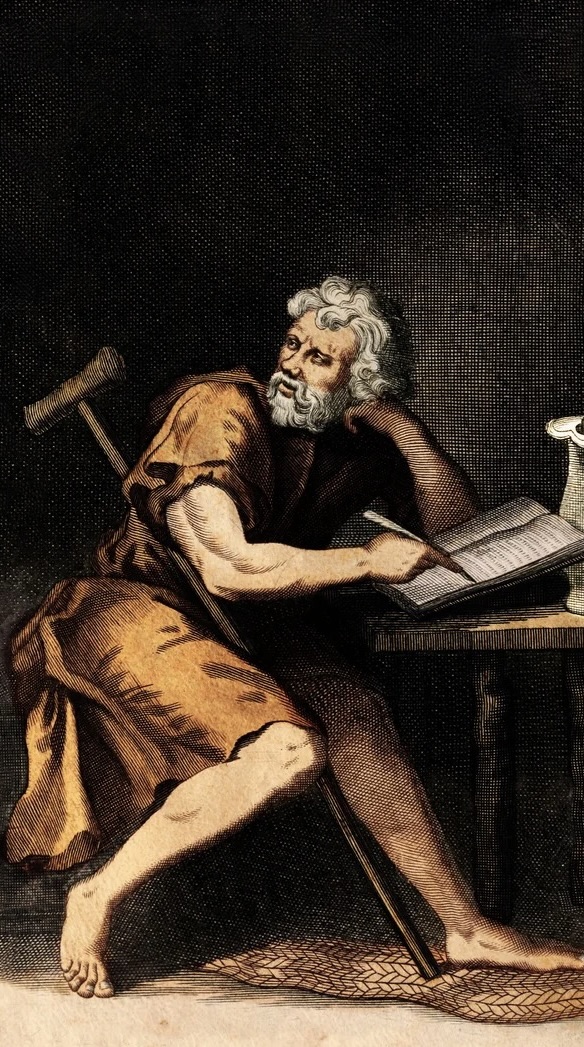
Under the guidance of Musonius Rufus, Epictetus learned a great deal about Stoic ideals which greatly influenced his outlook on freedom. He insisted freedom could never be bought or granted by another. Rather, it could only be achieved if one could master their own mind. During his time in slavery, Epictetus also suffered a severe affliction that left him lame. Sources disagree on how he sustained such an injury, with the more famous account coming from the writer Celsus. He wrote that Epictetus’ leg was deliberately broken by a cruel master. Whereas a separate source suggested his disability resulted from illness. Whatever the truth, his lameness took on a central role in his later teachings, in which he frequently asserts that while the body could be injured, weakened or even imprisoned, nothing can affect prohairesis or human will unless an individual chooses to surrender it.
Freedom, Exile and Mastery
Emperor Nero's death on June 9, 68 AD brought an end to the once powerful Julio-Claudian dynasty. With this the Roman Empire entered a new beginning, one that would have lasting effects for Epictetus himself. Epaphroditus, a former slave himself, granted Epictetus his libertas, making him a free citizen of Rome. With his newfound freedom, Epictetus did not embark on a path in search of riches or political power. Rather, he devoted himself entirely to both teaching and studying philosophy. Over the next decade, he earned a reputation as one of the city’s most respected Stoic thinkers, and his lectures brought in students from across Roman society. Yet the very ideals at the heart of his teachings: virtue, inner freedom and independence, stood in opposition to the authoritarian atmosphere of the Imperial government, and before long, Rome decided to act on what it considered a political threat and breeding ground for dissent behaviour. In 93 CE, the Emperor Domitian issued a decree that forced all philosophers from both Rome and Italy into exile.
Epictetus himself accepted his banishment without hesitation and left for Nicopolis, a bustling metropolis on the western coast of Greece. Once there, he founded his own philosophical school that attracted aspiring magistrates, aristocrats both young and old and even military officers from across the Roman world who traveled considerable distances to attend his lectures, not to become masters of argument, but to cultivate virtus, the moral excellence that Stoicism regarded as the one true form of good.
The Legacy of Discourse
Epictetus’ forced exile was by no means the end of his remarkable story, but the start of his legacy. While Emperor Domitian's decree had silenced philosophers in the city of Rome, it provided figures such as Epictetus with an opportunity to establish themselves elsewhere. At his school in Nicopolis, his reputation grew over time, eventually making him one of the most influential Stoic philosophers in Roman history. Those who attended his lectures were met with a figure who passionately explored every aspect of the human condition, frequently arguing that philosophy was more than an academic discipline: it was a way of life.
In his iconic lectures, Epictetus explored every aspect of the human condition, arguing that philosophy was much more than an academic discipline: it was a practical way of life. He famously compared his classroom to a physician's surgery, implying that those who attend his class should not leave feeling entertained, but healed. His talks challenged the idea of ambition, pride and fear with equal force, urging his students to examine their own character before attempting to change the world around them. Almost everything we know about Epictetus today comes down to us from the writings of his pupil Flavius Arrian. Recognizing the importance of his teachers' words, Arrian preserved both Epictetus’ lectures and informal conversations in the Diatribai (Discourses) and the more concise Enchiridion (Handbook). As Epictetus never wrote anything himself, these surviving works became the foundation of his legacy.
Outside of his school, Epictetus lived a fairly modest life. He was not interested in luxury and owned little more than was required for his everyday life and studies. Nor did he show any interest in the mos maiorum of wealth or social status that occupied the minds of his contemporaries. This didn't mean he was entirely detached from the world. In his old age, he allegedly adopted a child who had been abandoned by the parents. He did his best to raise him with the help of a paid companion. This act reflected the principle of humanitas, or compassion and duty, which lay at the heart of Stoic ethics. When Epictetus died around 135 CE, he left behind no great fortune, nor a political dynasty; instead, he bequeathed something far more enduring: philosophical teachings that went on to inspire figures such as Marcus Aurelius and future generations long after the Roman Empire itself had faded into the background of history.
Bibliography:
Long, A. A. (2002). Epictetus: A Stoic and Socratic Guide to Life. Oxford: Oxford University Press.
Epictetus. (2014). Discourses, Fragments, Handbook (C. Gill, Trans.). Oxford: Oxford University Press. (Original work composed c. 95–135 CE).
Inwood, B. (Ed.). (2003). The Cambridge Companion to the Stoics. Cambridge: Cambridge University Press.