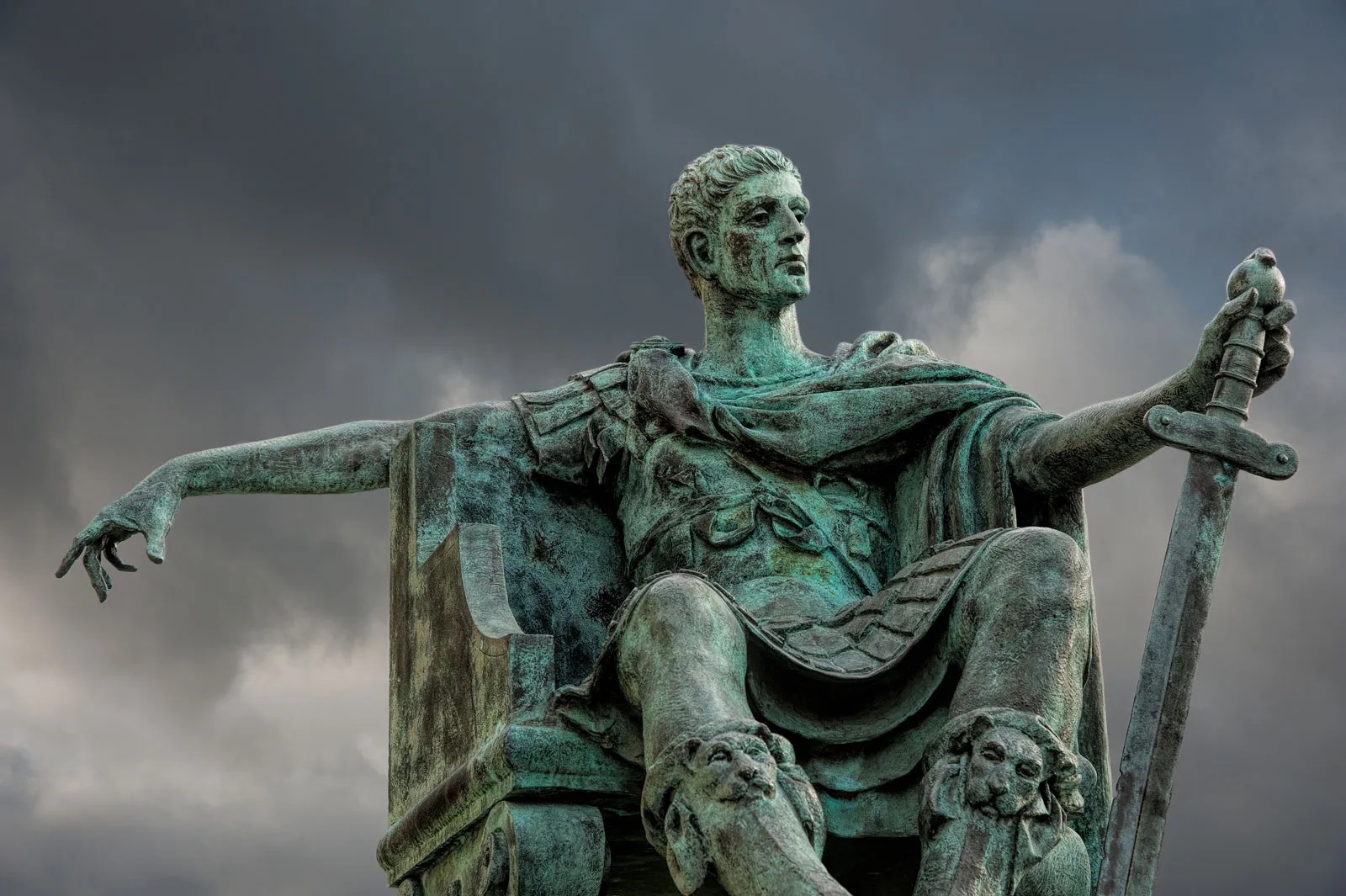
Constantine the Great (c. 273-337 CE), Flavius Valerius Constantinus, was perhaps the most consequential Roman emperor since Augustus. He became the first Christian Roman emperor and greatly facilitated Christianity’s rise. He chose the obscure port of Byzantium as the capital and modestly named it after himself, Constantinople. He was a brilliant and successful commander. He gave dowries to orphan girls so they could marry and was charitable to the poor. He was also ruthless, throwing defeated Germanic chiefs to the beasts in the Colosseum at Trier. He had his son Crispus executed and Fausta, his second wife, killed.
Constantine was born around 273 CE in Naissus, now Niš, Serbia. During his youth, Emperor Diocletian (r. 284–305 CE) reorganized the Roman Empire to help it respond more quickly to threats along its frontiers. Under the new system, known as the Tetrarchy, two senior emperors, the Augusti, shared power with two junior emperors, the Caesares. They governed from strategically located cities such as Trier, Milan, and Nicomedia. The system also provided for an orderly succession. When the Augusti retired, the Caesares would take their places and appoint two new junior emperors. Constantine’s father, Constantius, was one of the first two Caesares.
The system collapsed after Diocletian and his co-emperor abdicated in 305 CE. Constantine had joined his father in Britain, but Constantius unexpectedly died in Eboracum (now York) in 306 CE. His legions were fiercely loyal and proclaimed Constantine as Augustus. The result was a series of intermittent civil wars that ended in 324 CE with Constantine’s total victory.
Constantine was a competent soldier who had campaigned against the Persians. After the legions in Britain proclaimed him Augustus, he took command of most of the western provinces, invading Italy to defeat Maxentius, another claimant.
According to tradition, Constantine experienced a vision of a Christian symbol in the sky, the chi-rho, and the words In hoc signo vinces, “By this sign you shall conquer.” The symbol comes from the first two letters of the Greek version of Christ’s name, combining the Greek letter X (Chi) and P (Rho).
The next day at the battle of the Milvian Bridge outside Rome, Constantine defeated Maxentius’ army, which broke and fled. Before the battle, Maxentius had built a temporary bridge across the Tiber. The bridge collapsed under the weight of the fleeing troops, and many drowned, including Maxentius. Constantine adopted the sign as his standard, and it became a potent symbol of Christianity.
After his victory at the Milvian Bridge in 312 CE, Constantine and Licinius met in Milan in 313 CE and reached an agreement called the Edict of Milan. Although it was an agreement, not an edict, it established religious toleration, allowing Christians to worship freely and restoring confiscated Christian property.
The last years of the intermittent civil wars were between Constantine and Licinius, who ruled in the east. In 324 CE, Constantine inflicted a severe defeat on Licinius, and Licinius’ wife, Constantine’s half-sister, persuaded him to surrender. Constantine promised him peaceful exile in Thessalonica but broke his promise and had Licinius and his young son executed.
During the campaign against Licinius, Constantine became interested in the old port of Byzantium because of its strategic position on the waterway between the Black Sea and the Mediterranean. He decided to make it into the imperial capital.
Legend has it that he walked outside the city with a spear, marking the ground to show the extended limits of the city’s expansion. When asked why he included a large area not yet built on, the emperor said he was following a vision of Christ. Constantine formally dedicated the city in 330 CE and named it Constantinople, the city of Constantine. He built several large churches, but also pagan temples and a large statue of himself in the city center.
In the decade following the Milan Edict, Constantine issued more edicts that allowed Christians to serve in high office, exempted clergy from municipal obligations, and returned Christian property confiscated during Diocletian’s persecution of Christians. An edict in 321 CE ordered all public work to cease on Sunday. Taken together, Constantine’s efforts positioned Christianity to become the state church of the empire, although that did not become official until 380 CE when Theodosius issued the Edict of Thessalonica.
Constantine abolished the Praetorian Guard, replacing it with a new guard, the scholae palatinae. He reorganized the army, enlarged the Senate, and created a new class of imperial companions, the comites consistoriani. He also introduced the solidus, a gold coin that remained the standard for most of the Byzantine Empire’s history.
Another important event in Christian history occurred in 325 CE, when Constantine called for the empire’s bishops to meet in the city of Nicaea (in Turkey) to resolve conflicts within the church. A particularly divisive issue was the Arian controversy. Arius, an influential presbyter from Alexandria, argued that Christ was a created being and therefore lesser than God. The most important result of the deliberations was a statement of faith affirming that Father and Son were of the same substance. This became the Nicene Creed, which most Christians still recite.
The darkest time in his reign came in 326 CE. He executed his son Crispus, an accomplished commander who had helped defeat Licinius, and his wife Fausta died in the baths under mysterious circumstances. Later writers claimed that Fausta accused Crispus of attempting to seduce her, enraging Constantine, who ordered the execution, and that, on discovering the claims were false, Constantine had Fausta killed. Fausta’s motive may have been to advance her three sons with Constantine. Crispus was the emperor’s oldest son, by his first wife, Minervina. The truth remains unknown.
Soon after, Helena, Constantine’s mother and a devout Christian, went on a long pilgrimage to Palestine in 326-328 CE, visiting sites significant to Christians. She financed several churches. A later tradition described her as searching for fragments of the True Cross and finding some, bringing them to Constantinople. She became recognized as a saint and still has a feast day.
Constantine died in May of 337 CE in Nicomedia, preparing for an invasion of Persia. Convinced that death was near, he was baptized. His body was carried to Constantinople to the Church of the Holy Apostles, which featured a symbolic sarcophagus for each Disciple. Constantine was placed in the middle, six on each side, implicitly making him the thirteenth. The fate of his remains and those of St. Helena are unknown because the imperial tombs suffered damage and destruction over the centuries, including in 1204 when the Fourth Crusade went astray and sacked the imperial city. Helena’s porphyry sarcophagus does survive in the Vatican Museums.
Centuries after Constantine’s death, medieval popes invoked a gift he had never made. The Donation of Constantine, an eighth-century forgery, tells how Pope Sylvester I cured the emperor of leprosy in Rome. In gratitude, Constantine supposedly granted the pope sweeping authority over the Church and control of Rome and other territories in the Western Empire. Medieval popes cited the document to bolster their claims to political power. In 1440, the Renaissance scholar Lorenzo Valla exposed the forgery by showing that its Latin contained words and usages that would have been out of place in Constantine’s day.
References:
Clemens Peterson. “Emperor Constantine the Great (c. 274- 337). Earlychurch.org.uk. https://gospelstudies.org.uk/earlychurch/constantine.php?utm_source=chatgpt.com#gsc.tab=0.
The Ohio State University eHistory. “Flavius Valerius Constantinus (Constantine the Great), Roman Emperor. https://ehistory.osu.edu/biographies/flavius-valerius-constantinus-constantine-great .
Wasson, Donald. “Constantine I.” World History Encyclopedia, April 19, 2013. https://www.worldhistory.org/Constantine_I/?utm_source=chatgpt.com