If you walked through the streets of Rome on the morning of a big race day, you would feel the excitement in the air long before you reached the stadium. Vendors would be shouting, people would be arguing about their favorite teams, and thousands of Romans would be rushing toward one place: the Circus Maximus. In many ways, it was the ancient world’s version of the Super Bowl; loud, crowded, dramatic, and absolutely impossible to ignore.
Racing has always been a favorite pastime and a sport that millions still watch today, but the most famous racing venue ever is not the Monaco Street Circuit but the Circus Maximus of Rome! The Circus Maximus was the largest stadium in Ancient Rome. Located in the valley between the Palatine and Aventine hills, it could hold more than 150,000 spectators. Some historians even think the number may have been closer to 200,000. That is far bigger than most modern sports stadiums. The arena was home to some of the most spectacular racing events and became a symbol of Roman games for centuries. When races were held, the stands filled with citizens, senators, merchants, soldiers, and enslaved people. For a few hours, everyone in Rome gathered together for the same purpose: entertainment.
The origins of this spectacular arena date back to the Kingdom of Rome in the 6th century BCE, centuries before it became the most famous home of racing and other athletic events. Lucius Tarquinius Priscus, the fifth Roman king and the first Etruscan to sit on the Roman throne, is credited with building the first permanent wooden structures on the site in the 6th century BCE, with concrete and stone construction taking place between the late 4th and 2nd centuries BCE during the Roman Republic.
This was the foundation that would become known as the Circus Maximus, or the Greatest Circus. This does not refer to a great big circus as one might think of today, with clowns or elephants, but rather to a massive racetrack where chariot racing and other festivities were held before spectators. It was not until the rise of Julius Caesar towards the end of the Republican era in 50 BCE that the Circus Maximus became recognized as a huge architectural and cultural achievement.
The Palatine Hill was where the imperial family lived, so the arena was perfectly situated for the emperor and his courtiers to attend events easily. By the height of the Roman Empire, the Circus Maximus had become a popular and vitally important stadium for the most prestigious races in the ancient world. Aside from racing, gladiatorial games and festival events were also held there, often as part of the Roman Games or Ludi Romani, to honor the god Jupiter.
The seating enveloped the entire arena; the lowest level was made of marble, while the rest of the audience space was a mix of stone, concrete, and wood, and stood three stories high. The emperor’s private box was neighbored by sequestered seating for politicians, senators, military guests, and other notable individuals. Admission to the stadium was free, so the entire arena was often filled with eager onlookers. Food, drinks, and other concessions could be purchased outside the arena, and betting played an important role in the races.
The track itself lay around 1772 feet by 263 feet (about 540 meters by 80 meters). In the center of the track was the euripus, a ten-foot-wide (3 meters), ten-foot-deep (3 meters) channel of water that ran down the center of the road to indicate turning positions for the charioteers. Tall obelisks with statues highlighted the spina, the turning posts at either end of the track. Twelve arching gates marked the entryways for the charioteers, who would ride out to the roar of the crowds, salute the onlookers, then start their race.
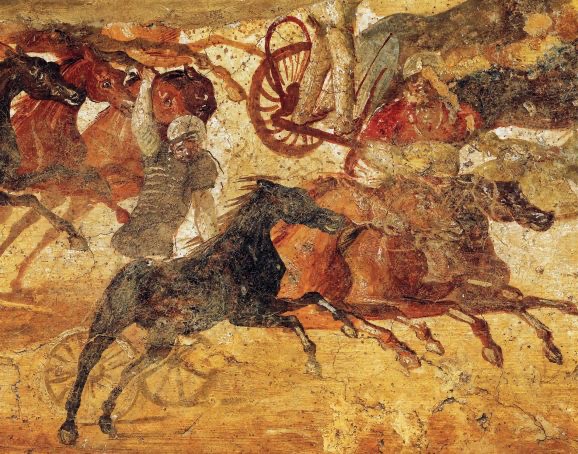
The chariots were fast and light, most likely made of light wood and leather, with strong wooden and iron wheels, and pulled by teams of 4, 6, 8, or 12 horses. The charioteers wore leather helmets and colored tunics or vests to signify their division. The horses circled the track seven times for the seven hills of Rome, completing about seven miles total. It was an incredibly dangerous sport, and crashes, or naufragia, were common, much to the delight of the crowd, and death was always hanging overhead.
Roman fans were also fiercely loyal to their teams. These teams were known as factions, and each one had a color: Red, White, Green, and Blue. Supporters proudly wore their team colors and argued passionately over which faction was best. If this sounds familiar, it should. Modern sports fans behave in almost the same way. Romans shouted, celebrated, complained about bad calls, and bragged when their team won. In other words, they were not very different from fans today.
Victorious charioteers received massive cash rewards and countless prizes, and the betting spectators would be forever indebted to the skills of the racers. The most famous was Flavius Scorpus, a young Iberian slave who bought his freedom thanks to becoming a legendary racer, coming to prominence in the 1st century CE with repeated victories at the Circus Maximus as part of the green group. Before his death at twenty-seven, Scorpus won over 2,000 races and became known as a militaries, or racer.
Roman writers sometimes criticized this obsession with entertainment. The satirist Juvenal famously complained that the people cared about nothing except panem et circenses, “bread and circuses.” In other words, as long as the government provided food and entertainment, many citizens stopped worrying about politics. The Circus Maximus was not just about sports; it was also part of how Roman leaders kept the public happy.
But for ordinary Romans, the races were something more simple—fun. Life in ancient Rome could be difficult and stressful. A day at the Circus offered a chance to forget problems and enjoy the excitement of the moment. As one famous Latin phrase reminds us, carpe diem, or ‘seize the day.’
Bibliography:
Cartwright, Mark. “Circus Maximus.” World History Encyclopedia. May 16th, 2018.
Humphrey, John H. “Roman Circuses: Arenas for Chariot Racing.” Berkley: University of California Press, 1986.