Many of us know the legend of the Roman Empire. What we might not know are some of its more scandalous details. One of these was the story of the murders of the Gracchi brothers.
Rome was expanding and taking control of the Mediterranean basin. With these conquests, new problems arose for the Roman Republic. As its leaders tried to adjust to the expanded Republic, they also found themselves confronting problems emerging within the government. Men began to pursue reforms that would benefit the Republic and certain factions of society—and, ultimately, themselves. The result was blood on the Senate’s hands. The deaths of reformers were deemed necessary for the survival of the Republic and the protection of the oligarchy’s interests.
The oligarchy could not adequately handle these new issues. Its members had never encountered anything like the vast need for land reform, which ultimately shaped the Roman military, or the desire of so many people to be recognized as Roman citizens. The Republic’s growing pains began to be felt. Each member of the oligarchy was searching for a solution in which everyone would win—especially himself.
The situation was particularly difficult for the oligarchy because it had begun to change from within. Its members were linked through blood and marriage and had historically remained tightly united. After the Second Punic War, however, “its formerly strong corporate sense had been overtaken by the ambitions of individuals and factional groups.” Self-interest began to take center stage as the two families of the Scipiones and Claudii sought power. The result was drastic action against anyone deemed to be acting in a manner that might diminish the oligarchy’s power. Two men holding positions of Roman authority attempted to enact reforms that ultimately led the oligarchy to murder them and their supporters. The end of the Republic was underway.
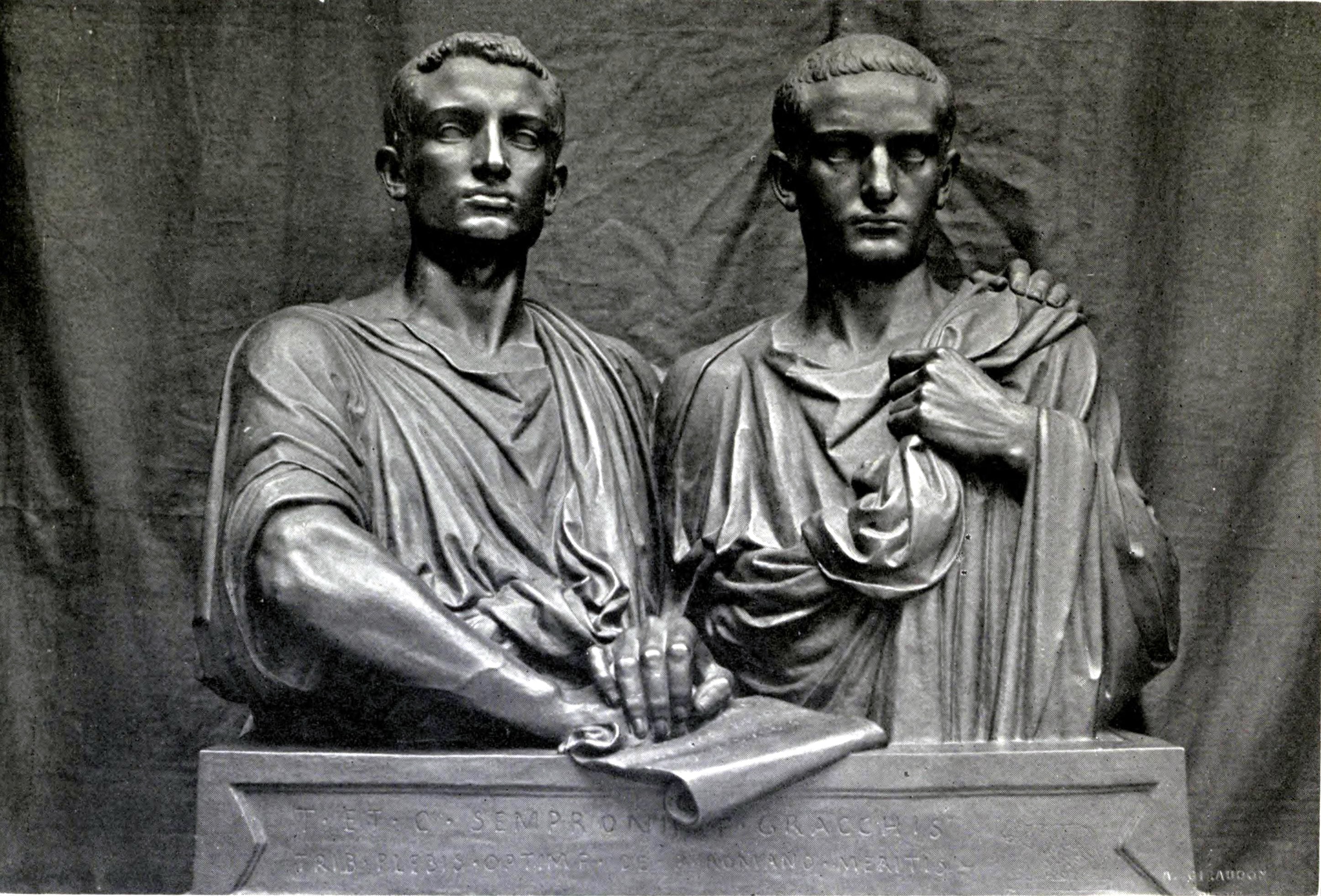
Tiberius Sempronius Gracchus and Gaius Gracchus were brothers who saw an opportunity to introduce reforms that would ease the difficulties caused by Rome’s new acquisitions while advancing their own careers. Between them, they proposed reforms intended to benefit the military and improve the Republic’s economic condition. Each reform was met with resistance.
Huge tracts of land confiscated after the Punic Wars became public property. Over the years, this land was illegally occupied and farmed. Tiberius viewed the public lands as a possible solution to Rome’s military and agricultural crises. Distributing this land to the landless would “enhance the body of manpower available for legionary recruitment.” This was because military recruitment was based on a family’s economic worth. Those who fell below the minimum property qualification did not have to serve the Republic.
When Gaius later became tribune, he pursued reforms that also encountered opposition. His grain-distribution law was intended to make grain available at reasonable prices. In addition, he proposed citizenship reforms that would give “full citizenship to half citizens and half citizenship to non-citizens.” Gaius established a minimum age for military service and attempted to advance his brother’s land-distribution proposal.
All these reforms were heavily opposed within the oligarchy. The most vocal opponent of land redistribution was M. Octavius, who argued that redistribution was unfair to those farming the land and treating it as property that could be used for dowries or passed down in their wills. Trouble arose when Tiberius bypassed the Senate and appealed directly to the Assembly to secure passage of the land-redistribution bill. This action provoked even greater protests.
Tiberius was manipulating the situation for his own benefit. The bill would win him many supporters while weakening the Senate’s authority. This was the first time that a member of the oligarchy had used “popular discontent to further his own career.” His goal might have been reform, but his methods undermined the government. When Octavius objected, Tiberius used his power to remove him from office. The bill was practically forced through.
The oligarchy viewed the Gracchi brothers and their allies as a group “attempting to maneuver itself into a position where, by ‘stealing’ its opponents’ clientage and controlling an arm of government, it could control Rome in a quasi-regal fashion.” Fear spread throughout the oligarchy as its members perceived a movement toward kingship. For many Romans, the Republic had been designed specifically to prevent one person or family from ruling over them. The interests of individuals were now rising above those of the Republic.
The brothers were considered manipulative and appeared to be building a political base for their own rise to power. Their opponents felt so strongly that they attacked Tiberius and nearly 300 of his followers. The chief priest, Scipio Nasica, claimed to have killed Tiberius himself because he believed that Tiberius wanted to become king. When Gaius encountered the same passionate opposition, he formed a bodyguard but still met his death on the Aventine Hill. Thousands would die in the supposed defense of the state.
These murderous acts changed Rome forever. Everyone was now acting in his own interest. The oligarchy declared that all its actions were intended to protect the Republic, and strong arguments could be made in support of this claim. Yet these actions also protected the oligarchs’ positions and political power. What was done to save the Republic ultimately brought it down and opened the way for the very monarchical rule that its leaders had feared. Self-interest and the protection of the state became intertwined and indistinguishable. In the end, the Senate acted in its own interest under the guise of protecting Rome.
Bibliography:
Appian. Roman History, Volume III: The Civil Wars, Books 1–3.26. Translated by Horace White, Harvard University Press, 1913.
Plutarch. “Tiberius Gracchus” and “Gaius Gracchus.” Lives, Volume X: Agis and Cleomenes; Tiberius and Gaius Gracchus; Philopoemen and Flamininus. Translated by Bernadotte Perrin, Harvard University Press, 1921.
https://www.loebclassics.com/view/LCL102/1921/volume.xml
Stockton, David. The Gracchi. Clarendon Press, 1979.
https://global.oup.com/academic/product/the-gracchi-9780198721055
Lintott, Andrew. The Constitution of the Roman Republic. Oxford University Press, 1999.