In 44 BCE, an eighteen-year-old stood poised to inherit the most dangerous name in Rome. Born Gaius Octavius in 63 BCE to a respectable but unremarkable family, he was Julius Caesar’s great-nephew through Caesar’s sister, Julia. Then Caesar was assassinated, his will was opened, and Octavius discovered that his great-uncle had posthumously adopted him as his son and named him principal heir. He inherited Caesar’s fortune, but also his soldiers, enemies, and unfinished ambitions. Few could have expected the sickly teenager to survive Rome’s political bloodbath, much less master it.
Yet Octavian proved himself perhaps the most adept politician in Roman history—and possibly its richest. In his brief autobiography, he claimed to have distributed more than two billion sesterces to the Roman people. Suetonius portrays him as handsome and eloquent, restrained with wine, attentive to his appearance, and decidedly less restrained when it came to adultery. From this unlikely mixture of calculation, charisma, contradiction, and inherited power emerged the man who would create a monarchy without ever calling it one and build a political system that endured for the next four centuries.
When he heard of his uncle’s assassination, Octavian was in Apollonia in Epirus. He returned to Rome to discover he had been adopted by Caesar. He immediately began to establish popularity with the public, spending lavishly on public entertainment and winning over troops loyal to Caesar.
Octavian and Antony emerged as the major powers in the Roman world following Caesar’s murder. They joined to go after the assassins, who were led by Marcus Junius Brutus and Gaius Cassius Longinus. The three most powerful men in the Roman world, Octavian, Antony, and Marcus Aemilius Lepidus, were granted extraordinary powers by the Senate in 43 BCE, forming a triumvirate initially for five years. They defeated the assassins in battle at Philippi in Macedonia. Both Brutus and Longinus committed suicide.
The three triumvirs divided up the Roman provinces: Octavian got the west; Antony got the east, and Lepidus got Africa. Antony became caught up in Egyptian politics and fell hard for Egypt’s ruler, Cleopatra VII, who also had a relationship with Julius Caesar for a time.
Octavian got his hands on Antony’s will and used it to blacken Antony’s reputation. Romans were particularly outraged that Antony was going to turn over Roman territory to Cleopatra. Octavian managed to deprive Lepidus of his legions and send him into exile, although on comfortable conditions. Octavian’s relations with Antony deteriorated, and finally civil war broke out.
Octavian seems to have been an effective commander, but his great victories were achieved by superb officers he had appointed, recognizing their talent. The greatest was Marcus Vipsanius Agrippa, who helped win the empire for Augustus at Actium, defeating Mark Antony and Cleopatra. Agrippa’s loyalty was unwavering, and he eventually became the emperor’s son-in-law.
The crucial battle between Octavian and Mark Antony was a naval struggle at Actium off the west coast of Greece on September 2, 31 BCE. When it became evident that Octavian was winning, Cleopatra’s fleet broke off and escaped, taking Antony with it. Octavian pursued them to Egypt, and both Antony and Cleopatra killed themselves in 30 BCE. The victory left Octavian alone in control of the Roman world. He added Egypt to the empire, and because he administered it as an imperial province, he controlled its wealth. He appropriated Cleopatra’s treasures and used them to solidify his popularity.
When Octavian returned to Rome after defeating Antony and Cleopatra, it was already the largest and richest city in the entire Mediterranean, with a population that may have been a million or more. Rome consumed more wealth than it produced, but Octavian’s lavish spending bought great popularity, as did his vast construction projects. Among other projects, he rebuilt temples, constructed new ones, and assured food and water supplies. He established a fire department and a night watch. He famously claimed that he began with a city of bricks and left Rome as a city of marble. These improvements considerably increased his popularity.
The Senate awarded Octavian the title of Augustus in 27 BCE, the name history knows him by. It meant roughly “revered.” This is the point when historians stop calling him Octavian and start referring to him as Augustus.
Augustus developed what today would be called a civil service, systematizing governance with qualified officials. He reformed the rickety old tax structure, assuring regular pay for the army and navy.
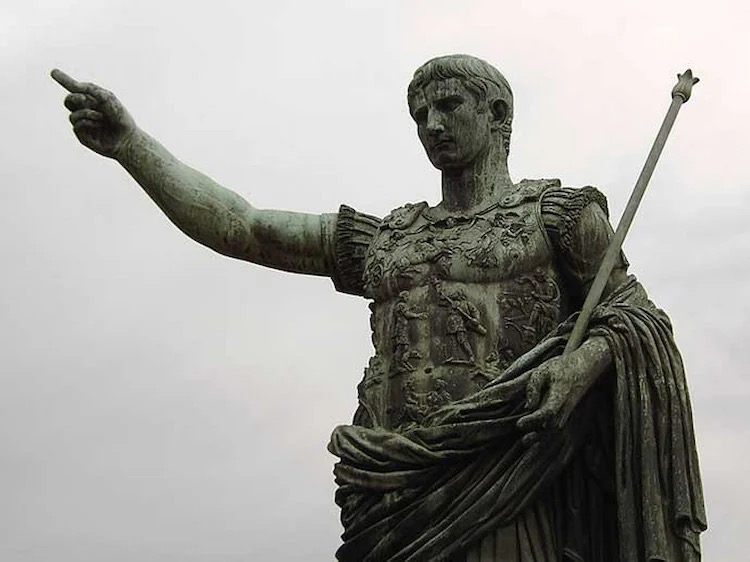
Augustus was an accomplished propagandist. Julius Caesar had been the first major ruler to have his likeness put on coins, beginning in 49 BCE. Augustus saw the value in spreading his image throughout the empire. Coins were used for daily transactions, and his image was thus seen almost daily. He also had court official sculptors develop prototype images as busts and statues, which were copied across the empire. The images all portrayed a man in the prime of his life.
He pushed hard to recover traditional Roman values. He passed laws related to traditional morals, the Lex Iulia de maritandis ordinibus and the Lex Iulia de adulteriis coercendis, in 18-17 BCE. This legislation penalized celibacy and childlessness, and provided incentives for marriage. Adultery was strongly condemned, and Augustus went so far as to exile his daughter Julia to a remote island as punishment for her adultery.
There is a certain hypocrisy involved here, given Suetonius’ observation that Augustus had a penchant for adultery. But in public, he was a restorer of tradition and an exemplar of behavior.
He was deeply affected when an alliance of German tribes led by Arminius annihilated three Roman legions under General Varus in the Battle of the Teutoburg Forest in 9 CE. Suetonius says Augustus mourned for months, forgetting to trim his beard or cut his hair. He says that Augustus banged his head in doors, saying “Quintilius Varus”—give me back my legions!”
Augustus died, appropriately enough, in August of 14 CE. Shortly before his death, he wrote his own version of his rule, presenting himself as a servant of the Roman people, a text that came to be called “The Deeds of the Divine Augustus.” In it, he presented his reign as one of prolonged service to the public.
At the height of his power, his full title stretched almost as far as the empire he ruled: Imperator Caesar Divi Filius Augustus, Pontifex Maximus, Consul XIII, Imperator XXI, Tribunicia Potestate XXXVII, Pater Patriae. Every word told a carefully crafted story. He was a victorious commander, the son of the deified Julius Caesar, Rome’s chief priest, thirteen-time consul, holder of tribunician power for thirty-seven years, and “Father of the Country.” Yet one word was conspicuously absent: king.
Augustus understood that Romans despised monarchy, so he did not abolish the Republic with trumpets and swords. He hollowed it out quietly, preserving its Senate, elections, offices, and reassuring vocabulary while gathering their powers into his own hands. He called himself princeps or “first citizen” as if he were merely first among equals. The disguise was so convincing that Rome accepted one-man rule as republican restoration. Augustus did not destroy the Republic; he transformed it into an Empire while persuading Romans that nothing had changed. And it worked.
Bibliography:
Augustus. “The Deeds of the Divine Augustus.” 1998 translation by Thomas Bushell. Originally written in 14 CE.
Steven Fife. “Augustus’ Political, Social and Moral Reforms.” World History Encyclopedia, May 7, 2023.
Nancy Thompson. “Roman Art. A Resource for Educators.” Metropolitan Museum of Art, New York City, 2022.
C. Suetonius Tranquillus. “The Life of Augustus,” in The Lives of the Twelve Caesars. Loeb Classical Library edition, 1913. Originally written in 121 CE.