Ancient Rome did not disappear when its empire fell. Its visual language—arches, eagles, laurel wreaths, liberty caps, and solemn personifications of justice and peace continued to shape how later societies imagined authority, freedom, and civic virtue. These symbols have traveled across centuries and continents, repeatedly adapted by revolutionaries, republics, monarchs, and dictators. Their survival reveals not only Rome’s extraordinary cultural influence, but also the power of iconography to transform political ideas into instantly recognizable images.
The ancient Romans were quite sophisticated in projecting power. Many of the emperors were very effective at popularizing their personal brand. Part of how they did so was by manipulating symbols. An emperor spread his portrait across the empire on coins—money talked, and it told of an emperor’s victories or association with the gods. Emperors erected triumphal arches to celebrate victories. Magistrates walked the city surrounded by lictors carrying fasces, a symbol of power. Statues carried symbols such as the liberty cap, laurel wreaths, and olive branches; some with female personifications of Roman virtues like libertas (liberty), justitia (justice), and pax (peace). These ideological elements remain in use, seeking status through association with ancient Roman power.
The most immediately recognizable modern use of a Roman architectural form is the memorial arch. In Rome, triumphal arches were built to memorialize victories of emperors; a triumphal parade would be held that marched through the arch as part of a celebration. The most influential remaining arches in Rome are the Arch of Titus (81 CE), the Arch of Septimius Severus (203 CE), and the Arch of Constantine (315 CE).
The most influential modern arch in the Roman sense of honoring military victories was the Arc de Triomphe (1806-1836) in Paris, honoring Napoleon Bonaparte’s victory at Austerlitz. Napoleon crowned himself emperor of the French in 1804, and the arch represented his imperial ambition. Other notable arches include London’s Wellington Arch (1830) and New York City’s Washington Square Arch (1892). The Washington Square arch commemorated the 100th anniversary of Washington taking office as President. The form remains influential, and a huge new monumental arch is proposed for Washington, D.C.
An often overlooked symbol from Roman times is the pileus, or Liberty Cap. In Rome, the ceremony of freeing an enslaved person involved shaving his head, touching him with a magistrate’s rod called the vindicta, and presenting him with a felt pileus to wear. The cap and rod frequently appeared in sculptures of Libertas, symbolizing Liberty. The cap later became a symbol of freedom during the French Revolution. It was also used in the United States: Paul Revere engraved it on his 1768 Sons of Liberty Bowl, a silver vessel honoring the Massachusetts House of Representatives for defying the king.
The original design for the Statue of Freedom atop the U.S. Capitol Building showed her wearing a liberty cap, but Secretary of War Jefferson Davis, later president of the Confederacy, objected that a symbol of giving a slave freedom was too radical. They substituted it for a kind of military helmet. Nonetheless, several murals and paintings in the Capitol building depict figures wearing the cap.
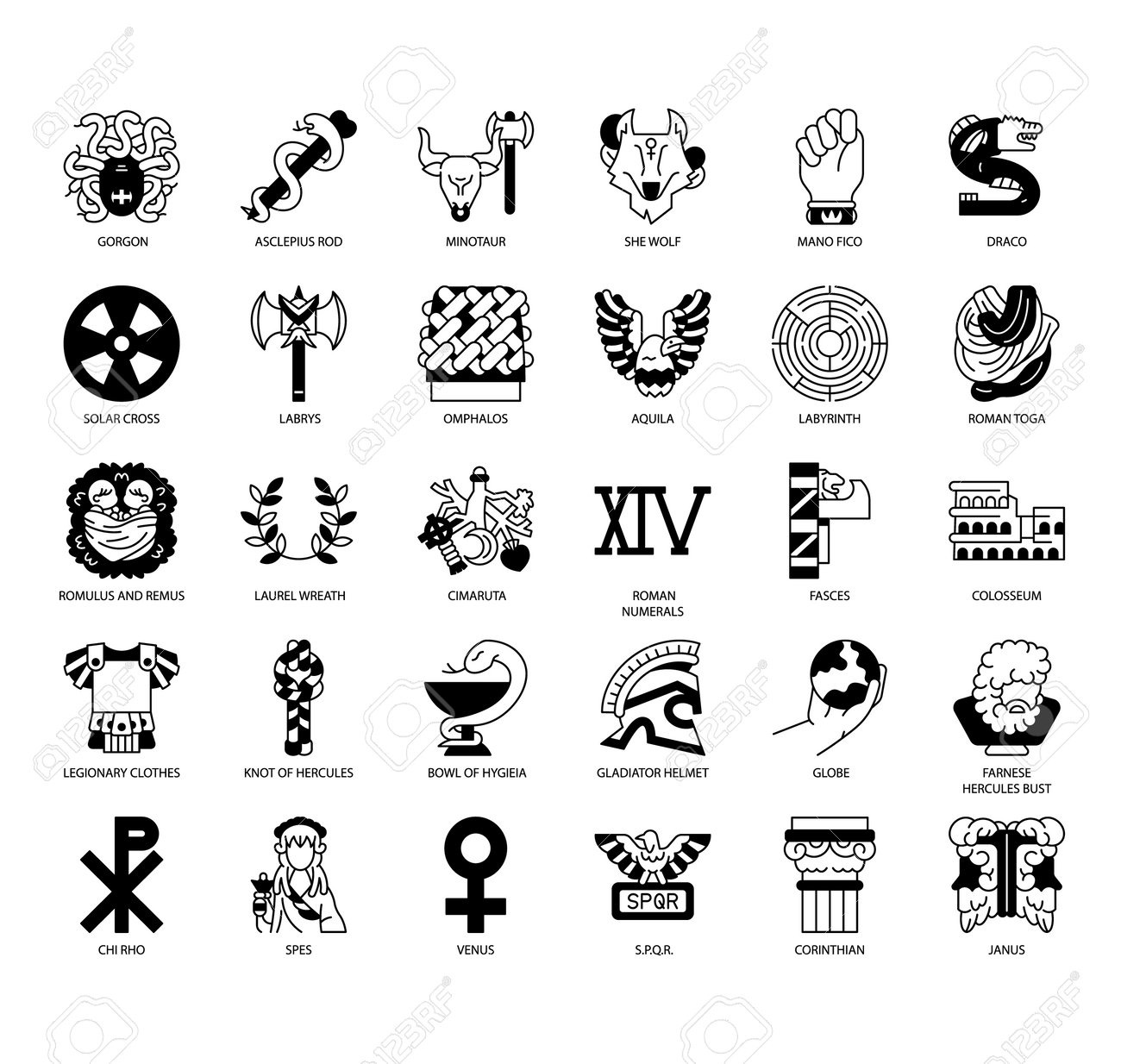
The Roman eagle, or aquila, was another powerful symbol. Each legion had its own eagle, and losing it in battle was considered a catastrophe. The eagle later became a national emblem. One variation was the double-headed eagle of Byzantium, Rome’s eastern successor, symbolizing dominion over East and West. After Byzantium fell in 1453, Ivan III, Grand Prince of Moscow, married the niece of the last Byzantine emperor, and the rising state of Muscovy proclaimed itself the Third Rome. The Byzantine double-headed eagle remains a symbol of Russia. The Holy Roman Empire and its successor, Habsburg Austria, also used it until 1918. Both empires gave their rulers titles derived from Caesar—Kaiser in German and tsar in Russian.
Perhaps the most widely used Roman iconographic symbol was the fasces. In Rome, this was a bundle of wooden rods, bound around a one-bladed axe. It was carried by lictors, servants who accompanied a magistrate such as a praetor, and symbolized his power, or imperium. The rods symbolized the power to discipline and the axe the power of execution. It was a stern and authoritarian symbol.
Since Roman times, the fasces has acquired a very different symbolic meaning, inspired by an ancient Aesopian fable. In the story, an old man shows his sons that a single stick can easily be broken, while a bundle of sticks bound together cannot. The lesson emphasizes the strength of unity. This interpretation of the fasces emerged much later, perhaps during the Renaissance, and became especially prominent in the United States. At the Lincoln Memorial, both of Lincoln’s hands rest above axe-less fasces incorporated into the front of his chair. In Jean-Antoine Houdon’s famous 1796 statue of George Washington, Washington’s left hand rests upon a tall fasces without an axe, while he stands beside a Roman-style military cloak.
The most significant use of the fasces was during Mussolini’s regime in Italy (1922-1943). The dictator revived many Roman symbols to equate his regime with ancient Rome. Mussolini’s use of the fasces with the axe was pervasive, and he used it to give a name to his political philosophy—fascism. It came to describe authoritarian regimes in Germany, Spain, and Japan.
One of the odder uses of Roman iconography is the City of Rome’s use of SPQR—Senatus Populusque Romanus. It is printed on manhole covers, sewer grates, garbage cans, public utility trucks, official documents, and the city seal. It’s a way Italy’s capital connects with its imperial history.
Roman symbols were common in paintings and statues honoring George Washington. Gilbert Stuart’s painting, known as the Lansdowne Portrait (1796), has Washington extending his right hand in the ad locutio position, symbolic of Roman orators.
Roman religious officials included the pontifices, members of Rome’s principal college of priests. Many Roman terms and institutions were later inherited or adapted by Christianity, which developed within the Roman Empire. The head of the Roman Catholic Church, the pope, is also known as the pontiff. A regional Catholic community is called a diocese and is headed by a bishop; the term originally described a Roman administrative district. Vatican City stands on Vatican Hill, which was not one of Rome’s famed seven hills. The Christian basilica likewise developed from the Roman basilica, a large public building used for courts, commerce, and assemblies.
Statues in conspicuous public spaces like courthouses and government buildings often take the Roman form of female embodiments of virtus. The Roman Justitia carried a sword and a set of scales to show the force of law and judgment based on weighed evidence. Contemporary statues symbolizing justice have added a blindfold. Statues embodying peace are still to be found in some public spaces. The grandest American embodiment of all in Roman form is the Statue of Liberty (dedicated in 1886) in New York Harbor. Her crown of rays, her tablet, and torch merge several classical traditions.
Roman iconography has therefore never remained fixed. The same symbol can represent liberation in one era, unity in another, and authoritarian power in a third. Arches, eagles, liberty caps, and fasces acquire new meanings whenever political movements and nations place them in new settings. Their continued presence shows both the enduring prestige of Rome and the flexibility of its visual language. Ancient symbols may appear timeless, but the agendas they serve are distinctly modern.
Bibliography:
AOC Staff. “The Liberty Cap, Symbol of American Freedom.” Architect of the Capitol, Washington, D.C., July 26, 2024.
T. Corey Brennan. “The Fasces: Ancient Rome’s Dangerous Political Symbol.” Antigone Journal, June 16, 2023. Antigonejournal.com.
Calder Loth. “The Triumphal Arch as a Design Resource.” Institute of Classical Architecture and Arts, August 1, 011.